How to organize your home for functionality, not for perfection

Every autumn, I get a yearning to organize my home and make it super tidy. Wouldn’t it be nice if everything was in its perfect place and looked just right?

However, this type of compulsion to tidy up can leave me overwhelmed and exhausted, as I wrote about in this blog post, so I resist it. I try to engage with it only as long as it’s helpful instead of when it’s making me annoyed or impatient.

I’ve read a couple of organizing books recently, and I’m currently reading Julie Morgenstern’s organizational classic Organizing from the Inside Out. While reading the first few chapters, I completely fell in love with the idea of a perfectly organized home. How pleasant and peaceful it would be to have a completely tidy room! But then I thought better of it. Is it really?

I noticed an interesting distinction: Julie Morgenstern talks about organization in terms of functionality and efficiency, while I think mostly about aesthetics. She emphasizes that you should observe your own habits and tendencies and build your environment in a way that supports you. For instance, if, after coming home, you like to dump your mail on the dining table, take that as a given. Perhaps place a box for incoming mail right there on the dining table or very close to it and create a routine where you go through that inbox every evening after dinner. It’s much easier to maintain a system, she argues, if it’s adapted to your needs rather than if you have to adapt to your system.

Adapt your organizational system to your habits

This has been a major light bulb moment for me. I don’t usually care much about functionality or efficiency. As long as things have a place, I’ll put them there, even if it’s a little inconvenient. But Jacob, my husband, really likes things being convenient, and I can see why.

So, right now we’re in the process of moving things around in our kitchen. In the past, we assigned spots for pots, pans, and plates based on where they fit. While this is also clearly important, sometimes the arrangement is not super convenient. We don’t keep our spices, for example, close to where we cook, and it’s not particularly nice to have to move spices back and forth across the kitchen multiple times. This means we end up leaving the most commonly used spices out on the counter, which annoys me.

As a solution, we’ve now moved our spices to a shelf right above the cooking area, which is super convenient. We used to keep our teas there, but teas don’t need to be close to the cooking area, so why keep them there? Hopefully, we’ll now put away our spices rather than leaving them on the counter.

This is a small example, but it has important consequences if applied on a larger scale. If things are convenient to use and easy to put away, then our organizational system has a much higher chance of surviving. Then, we can have a tidy home without the maintenance feeling tedious or burdensome.

Perspective shift

For me, this has a bigger consequence as well. Being tidy, to me, represents having things in perfect order. If one thing is in the wrong place, this means I’ve failed, which makes me so uncomfortable that I need to move this thing immediately.

In contrast, if the emphasis is on functionality, the whole perspective shifts. When things are reasonably tidy, great, the organizational system is working well. When things start getting messy, it means our habits have shifted a bit, and the current system doesn’t accommodate them as well as it could. We can identify the problem and make a few small changes, so the system starts working well for us again.

Note that the emphasis here is not on perfection. It’s on having a reasonably well-functioning organizational system. Also, it’s perfectly fine and part of the deal that we need to constantly keep adapting our system, so it can be in tune with our current habits and demands.

Do you have an organization system that works well for you? Or, on the contrary, one that doesn’t work well? Let me know by commenting below or on FacebookTwitter, or LinkedIn.

How I reached an optimal level of tidiness

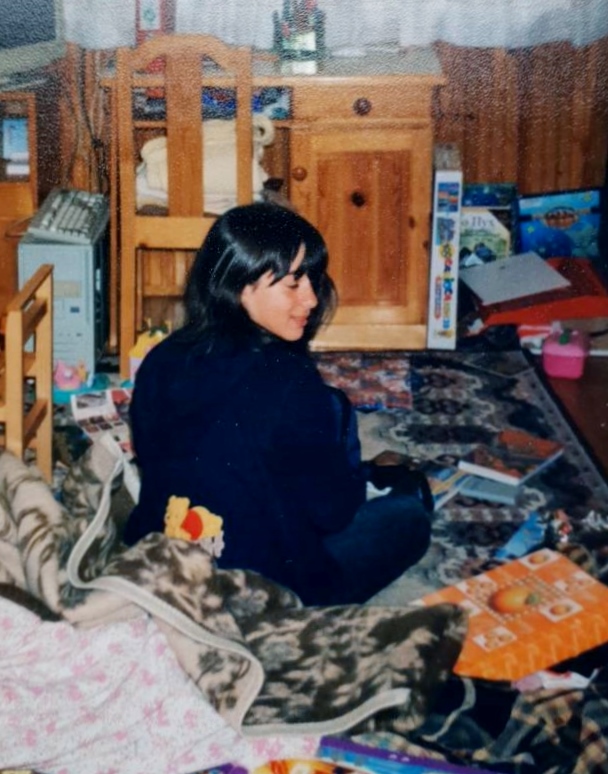
Photo: Me in my early teens, thriving on a messy room. Apparently, that’s possible too.

I love an organized house. If it were up to me, my home would be super tidy, and everything would have an exact place. It feels so peaceful to look at a perfectly organized room.

In fact, when I lived by myself, that’s how it was. I had a specific way of organizing the pillows on the couch or of putting the tea cups in the kitchen cupboards. When some friends came to visit, they found it extremely amusing that all my spices were arranged in rows, with the labels all facing forward. I didn’t get why this was so amusing; how could you possibly arrange your spices differently?!

The challenge

Things changes when Jacob and I moved in together. While he’s not extremely messy, he’s more towards the middle of the spectrum, while I’m at, well, one end of it. He was going to move into my place, but he owned quite a lot of stuff, so we very deliberately went through all his stuff, chose what to keep and what to give away or throw away. This was much better than just moving all his stuff.

For the sake of fairness, I went through my stuff and removed unnecessary items as well. After all, I wanted to make space for him to move in with me, and I didn’t mind getting rid of stuff I wasn’t using.

But when we actually started living together, I found it difficult not to have everything my way. He was good about being clean and more tidy than before, but things were still not how they had been when I lived by myself.

However, I realized that my standards were not realistic for other people and, honestly, they were too much even for me sometimes. I liked it when things were tidy, but it was exhausting to keep them like that all the time. It was irrational to expect another person to keep to my standards for no better reason than that I just liked things that way.

My own exposure therapy

So for the first one or two months of living together, I basically did a form of exposure therapy. I saw my spices arranged differently, not in rows, with some labels not facing forward (what a tragedy!). I had the urge to re-arrange them, but I resisted. I saw letters, keys, and wallets on the dining table and didn’t put them away. I saw my toothbrush and the toothpaste placed in a different spot on the sink and resisted the urge to move them back. (Nope, that one still gets me! There’s a just a specific spot where my toothbrush and toothpaste go!)

It wasn’t exactly easy to give myself this exposure to things not being in the way I’d place them. I realized what the problem was: I thought that whenever he left something in the “wrong” place, it meant he didn’t care. He was disregarding my preferences and, thus, my feelings. I told him about this, and he was rather surprised. He said the two things had nothing in common in his mind, and over time I came to believe him.

Knowing that this was important for me, he tried harder to be tidy. For instance, he began putting the car keys in the key bowl, so I could find them easily as well. Nowadays, if sometimes I accidentally leave the car keys on the table instead of in the key bowl, he calls out, “Where are the car keys? Why are they not in the key bowl?!” I apologize and promptly put them in the key bowl next time. Who would have thought this day would come!

The optimal level of tidiness

Unwillingly, I have to report that I’ve also become happier since things in our house became less strictly organized. It took a lot of pressure off of me! I didn’t have to always have everything in perfect order. If I didn’t feel like tidying up right this moment, I could leave it for later. This never felt possible before! In the past, the out-of-place objects had some sort of power over me, compelling me to put them in place.

Now, I can choose whether I want to put things away or not. I also don’t have to make the space perfectly organized, but it’s alright if it’s “good enough.” This “good enough” is still a work in progress, but it’s much less strict than before.

And, most importantly, I know that we can communicate about our living space. If at some point our surroundings get too messy and start annoying me, I can simply say to him, “Hey, things are getting a bit messy, do you mind if we tidy up a bit?” He understands what I mean, and we simply put things away.

And now that we’re about to have a baby, my tolerance for messiness needs to go way up! As I read in one book, “When your toddler is feeding himself, don’t try to run around, keeping the floor clean. Let it go! Your kitchen floor will be clean again once he goes off to college.” Oh, dear. That’s a long time to have a messy floor.

What is your optimal level of tidiness (or messiness)? Let me know by commenting below or on FacebookTwitter, or LinkedIn.

Photo credits: my mom.

How my husband and I decided to have a baby

We asked ourselves so many questions: “Are we ready to have kids? When is the right time to have a baby?” And perhaps the most difficult of all: “How do we know when we’re ready?”

“Kids are wonderful, but they also completely change your life.” At least that’s what I’ve heard–I have no experience myself, but that’s what people say. If having kids really is such a big life change, how do we decide when the right time is?

As you may have noticed, I like planning. Ironically, having kids is one of the most difficult things to plan in life. Does this mean we shouldn’t plan for it? I don’t think so. We can still create a draft plan and then adapt from there as life happens. One of the most important benefits of creating a plan is that it forces you to clarify to yourself what you want and why.

Early conversations

For Jacob (my husband) and me, talking about kids early on was very helpful. In the beginning of our relationship, we both mentioned that we’d like to have children one day, which was good to know.

A year later, we revisited the topic and decided we didn’t want to wait too long. It was 2017 at the time, so we said we’d probably start trying in 2019. That seemed a long while away, so we were relaxed.

Needless to say, I created three different timetables to visualize how starting at different times may develop over time. If we started trying in January 2019, assuming no complications or issues arose, we could be pregnant by July 2019. That meant the baby would be born by March 2020, and after that I’d take maternity leave (probably around 6 months). Afterwards, I’d resume my PhD by September 2020 and complete it (hopefully!) by the end of 2021. I created a table with the different time periods and also put them on a blank calendar with a yearly overview.

Then I did the same for two other starting dates. If we started trying six months later, everything would get shifted by half a year. In this case, especially if things didn’t happen too quickly, I was coming quite close to the end of my PhD, and being unemployed and pregnant seemed scary to me. And if we started trying once I was close to the end of my PhD, things would get shifted by about a year and a half. While that seemed less stressful (also because it was further away in time), it felt like too long from the present moment.

Is it really time?!

Towards the summer of 2018, we started thinking about it seriously. “Are we really going to start trying for a baby in 6 months?! That’s so soon!” Having a baby had always seemed like a huge deal to me, so it felt like the Earth should stop turning or something. But life was continuing around us at its usual speed: I was in the third year of my PhD, Jacob had started his own chiropractic practice, and we had scheduled our wedding for June 2019. Was it really the right time to have a baby?

At first, I told Jacob, “I think we should wait. I don’t think this is a good time for us to have a child.” He appeared a bit disappointed but conceded that we should start trying only when I was ready.

But then I remembered something a college professor of mine said to me one day: “It’s never the perfect time to have a baby. Don’t wait for the perfect time because it will never come.”

Remembering this stopped me in my tracks. What was I waiting for? We had a roof over our heads (a wonderful apartment, in fact), we were bringing in a decent income, we loved each other, and both of us were emotionally ready to have children. What more did I need?

Would it be better if we waited until after I finished my PhD? Maybe, but then I’d be looking for other jobs, so that would be stressful too. (Also, you can never know how long it will take to complete a PhD, so that’s a risky thing to bet on.) Would it be better if we waited until Jacob had been working at his practice for longer? Maybe, but we weren’t sure if that mattered so much.

Would it be a problem if I were pregnant at our wedding? (Spoiler alert: that was indeed the case.) I thought about this one long and hard. One of the main arguments against being pregnant at your wedding is that you can’t drink alcohol, but that didn’t bother me because I don’t drink alcohol anyway. My biggest issue was whether my wedding dress would look good. I can write much more about how I resolved this, but in the end I think it worked out well. And, finally, I was concerned that people would think we got married only because I was pregnant and not because we truly loved each other. Well, I had to let that go and accept that people would think whatever they want anyway.

Let’s go ahead…

In the end, we decided that the beginning of 2019 was as good a time as any to start trying for a baby. It wasn’t ideal, but it didn’t seem like we were going to find a more perfect moment. So we started, and here I am now, writing this blog post, and our tiny son is kicking excitedly in my belly. Yes, I’m writing about you, little one.

What do you think, how would you know (or how did you know) when you are ready to have kids? Let me know by commenting below or on FacebookTwitter, or LinkedIn.

Tidy up with purpose and not out of compulsion

We often tidy up because we are fed up with the way things are and we need to make a change. But we’d better approach our home and belongings with a sense of purpose.

A few weeks ago, on a Tuesday evening, I placed my dinner on the table and set up my tablet to watch an episode or two on Netflix. I had a new series suggestion, Tidying up with Marie Kondo. “Oh, no, no, no,” I thought to myself. “I can’t watch this, or I’ll turn into the tidying monster again.”

The perfectionist at home

When I lived by myself, everything had a specific place, and things were, almost always, in their exact place. I had a shelf for all my spices, and they were all arranged in rows, with the labels facing precisely forward. When friends came to visit, they marveled at my tidy, organized closets, cupboards, and shelves. They also thought I was a little crazy.

But more importantly, when something wasn’t in its right place, it made me stressed. I couldn’t let it go, and it gave me an unpleasant, gnawing feeling, like it was pulling me to fix it. And, inevitably, fix it I did. Every evening, I was organizing my clothes or cleaning the kitchen counters.

I was operating from the flawed belief that once everything is tidied up perfectly, I will finally be content and at ease. But that never actually happened. When I was done cleaning or organizing for the day, I tried not to look around for fear that I’d see something which had to be “fixed.” Because I was compulsively reacting to things that bothered me, I had to immediately eliminate the thing making me uneasy. There was no space to step back and let it go.

My spices were way more organized than this.
Image credits: Pixabay (CC0 license)

Exposure therapy

When my husband (then boyfriend) moved in with me, I experienced mild shock for a few months. I knew I couldn’t ask him to live by my unreasonable standards because I realized they weren’t helpful. But the fact that things were not in the way I liked them really bothered me.

I now understand that I was basically going through exposure therapy. I was being faced with the things that caused me stress, and little by little, their strength over me subsided. I didn’t have to fix things right away because even if things were not perfect, that was okay. Nowadays we have a reasonably tidy home, unbearably messy according to my previous standards but reasonably organized according to my current ones.

I still sometimes get annoyed by a messy pile of boxes or clothes, but I no longer react to the compulsive pull to fix it immediately. Instead, I can say, “Hey, I don’t like that pile over there, can you please take care of it?” and sooner or later, he’ll do it. Or, if it’s something I need to take care of it, I’ll set aside time on my calendar when I can tackle the issue.

The intentional approach to tidying & organizing

The goal is not to feed the compulsory need to tidy up immediately. Instead, the idea is to reflect purposefully on what we’d like and how we can make that happen.

I appreciate that about Marie Kondo’s method: she encourages people to think about what they want to keep and what they don’t, how they want to make use of their space and how they want their home to feel. It’s not about being super strict and keeping everything perfect all the time; rather, it’s about treating our home and our possessions with intention.

In the end, I am watching Tidying up with Marie Kondo. It has inspired me to clean out/organize a couple of areas of our home, but the effect has been very different from before. Instead of turning into the “fixing monster,” I’m much gentler to our home and to myself. My guiding goal is to make the space more pleasant, cozy, and usable instead of needing to eliminate and make it good enough, as though it wasn’t good enough already. And, most of all, I am grateful for such a wonderful home.

What do you think about tidying up? Do you have a tidying monster within, or are you quite content with how things are? Let me know by commenting below or on FacebookTwitter, or LinkedIn.

How I un-freaked myself out about planning my own wedding

I was seriously freaking out about my wedding. But once I figured out what was important to me and how to put that into practice, it became much easier and less stressful.

When I mentioned I am planning my wedding, many of my friends made jokes: “You love organization, so this must be heaven for you!” Everyone knows planning a wedding is stressful, but people assumed it was easy for me.

The truth is, it wasn’t heaven at all. I was freaking out. Completely! What kind of event should we have? Where should it be? How should we do it exactly? I had no idea.

Also, there are so many expectations around weddings. They are supposed to be gorgeous, elegant, fun, romantic, delicious (the food), entertaining… I felt like there was no way I’d be able to fulfill all these expectations and that the guests wouldn’t enjoy the event for one reason or another.

Whenever I shared this concern with friends, they said, “But you don’t need to worry about that! It’s not about the other people, it’s about you. This is your day!”

“Really?” I thought. “This is supposed to be my day? But if it really were my day, I would do it very differently.” But this was a strange thought because I had an idea of what weddings should be like, and that didn’t particularly attract me.


002201222567466706330096813.jpg

Photo credit: Logan Zillmer

I was fortunate enough to have multiple people around me consistently ask, “What do you want?” The truth was that I didn’t know what I wanted. I had never thought about it, and I had no clue.

In the end, it all came down to identifying my priorities. What’s important to me and what do I enjoy? I am not much into ceremonies and formal rituals, but I enjoy being in nature and being together with friends and family. (Fortunately, my fiance has the same priorities.) Once I identified these things as the most important, instead of expectations based on past experiences, things became clearer in my mind.

I also had to battle FOMO (the fear of missing out). What if, at some point in the future, I regretted not having a formal wedding? What if it turned out this was something I wanted?

I had to think about something Gretchen Rubin said: “If it’s right for us to throw something away, we should, even if someone else would pick it up.” In my case, it might be right for someone else to have a formal wedding, but it’s not the right thing for me. Why? Because it’s not what feels right right now. I have no idea what will feel important to me in the future, but I can try to figure out what feels right now.

Once I identified what my priorities are and what feels right to me, I knew what to do. As I described in the blog post about my system, I made a Trello board for our wedding, identified projects and tasks, and started getting stuff done.

Before, I had felt paralyzed and couldn’t start acting because I didn’t know what I wanted. But once I identified what I wanted and broke it down into manageable tasks, it became easy to act. It’s amazing how having clarity about what we want and why we want it can reduce our stress and get us going.

Have you been stressed about a major project you had to undertake? Did you find a way to reduce the stress and manage the project better? Let me know by commenting below or on Facebook, Twitter, or LinkedIn.