I’ve been thinking a lot lately about chaos and structure. Humans generally want to create things–that’s why we’ve invented stuff throughout history. The idea of chaos feels unkind and threatening, while structure feels soothing and protective.
We also have a desire for spontaneity, surprise, and novelty, but on the whole the drive to create structure is stronger.
However, a great deal of life is chaotic, and we’d be fighting an uphill battle if we tried to eliminate chaos. What we can do is to create structure amid the chaos. In this way, we can exert our influence over the things we deem important, while in other areas we can accept that things will go their own way.
Let me underscore that the goal should not be to control everything, and it should also not be to let go of all control. Let us exert our influence over the things that matter and let go of things we are (more) comfortable with letting go. Let’s pick our battles wisely.
Family life is chaotic
Now, getting practical. I can create a beautiful schedule to account for everyone’s activities, but it will never work out just as it’s laid out. My daughter may wake up an hour earlier or later than the schedule says. On the way to school, my son may refuse to put his shoes on and have a tantrum, causing a delay. There are too many variables to try to account for them all.
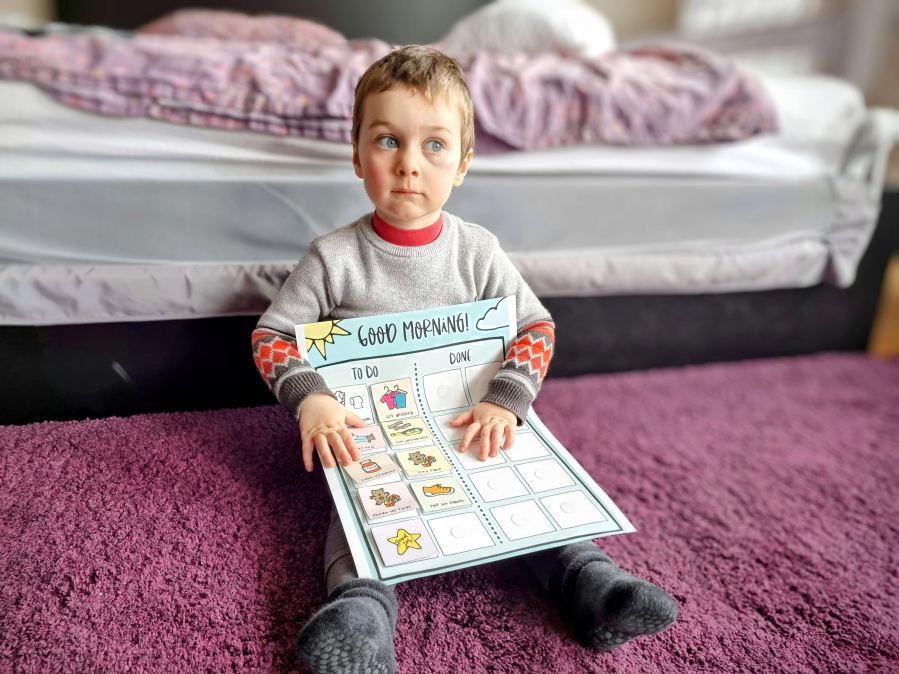
Instead, we can create a structure which acts as a backbone, guiding the rest of the variables. This is the goal of an effective routine, which is why morning and evening routines are so powerful and useful, especially with kids. Everyone knows what needs to get done and the (rough) sequence of activities–that’s the backbone that brings the activities in line.
The key to an effective routine is to be flexible in order to allow for variation. I know that sounds like an oxymoron–a flexible routine?! But this is the only way for a routine to be useful day in and day out.
A simple way to make a routine flexible is to allow for extra time. Let’s say you’ve timed your family’s morning craziness (ahem, routine), and it usually takes you around 1 hour and 10 minutes to get ready and out the door. When you do your planning, consider your morning routine to last 1 hour and 20 or 30 minutes, depending on how many people are getting ready (2 vs. 4, for instance; each added person brings in a larger degree of variability). This allows for things to go differently from how you planned: your child may be grumpy, someone may need to poop even though they don’t usually poop at that time of day, or someone may forget something (a backpack, a lunchbox, keys…). Let’s allow for things to go wrong in our system, so we aren’t thrown off course once something inevitably doesn’t go as planned.
Also, the sequence of things may need to be switched sometimes. For instance, if our baby wakes up at the same time as I do, I may feed her first and then get dressed, wash my face, etc.; if she sleeps a little longer, I’ll swap these two things around. Sometimes, our son wants to get dressed right after getting up, and other times he wants to eat breakfast in his pajamas. We allow for that flexibility on purpose because it makes him feel like he has a choice in how the morning routine unfolds. The truth is that he has a choice regarding some things and not others (most things, in fact), and it’s helpful in reducing tantrums to emphasize when he does have a choice. Similarly, he doesn’t get to choose all of his clothes because what he wears is weather-dependent, but he gets to choose his shirt (“Do you want a shirt with one dinosaur or three dinosaurs?”) and his socks (“Do you want socks with green, blue, yellow, or red dinosaurs?”). You have probably noticed we are in a dinosaur phase!
Chaos, unpredictability, and variability are inevitable in any life circumstances and certainly in family life. Our best bet is to embrace chaos, to count on things turning out differently from expected. At the same time, we can have systems in place that prevent things from falling apart, so the important things can still get taken care of.
 A Good Life