Embrace chaos. Build structure.

I’ve been thinking a lot lately about chaos and structure. Humans generally want to create things–that’s why we’ve invented stuff throughout history. The idea of chaos feels unkind and threatening, while structure feels soothing and protective.

We also have a desire for spontaneity, surprise, and novelty, but on the whole the drive to create structure is stronger.

However, a great deal of life is chaotic, and we’d be fighting an uphill battle if we tried to eliminate chaos. What we can do is to create structure amid the chaos. In this way, we can exert our influence over the things we deem important, while in other areas we can accept that things will go their own way.

Let me underscore that the goal should not be to control everything, and it should also not be to let go of all control. Let us exert our influence over the things that matter and let go of things we are (more) comfortable with letting go. Let’s pick our battles wisely.

Family life is chaotic

Now, getting practical. I can create a beautiful schedule to account for everyone’s activities, but it will never work out just as it’s laid out. My daughter may wake up an hour earlier or later than the schedule says. On the way to school, my son may refuse to put his shoes on and have a tantrum, causing a delay. There are too many variables to try to account for them all.

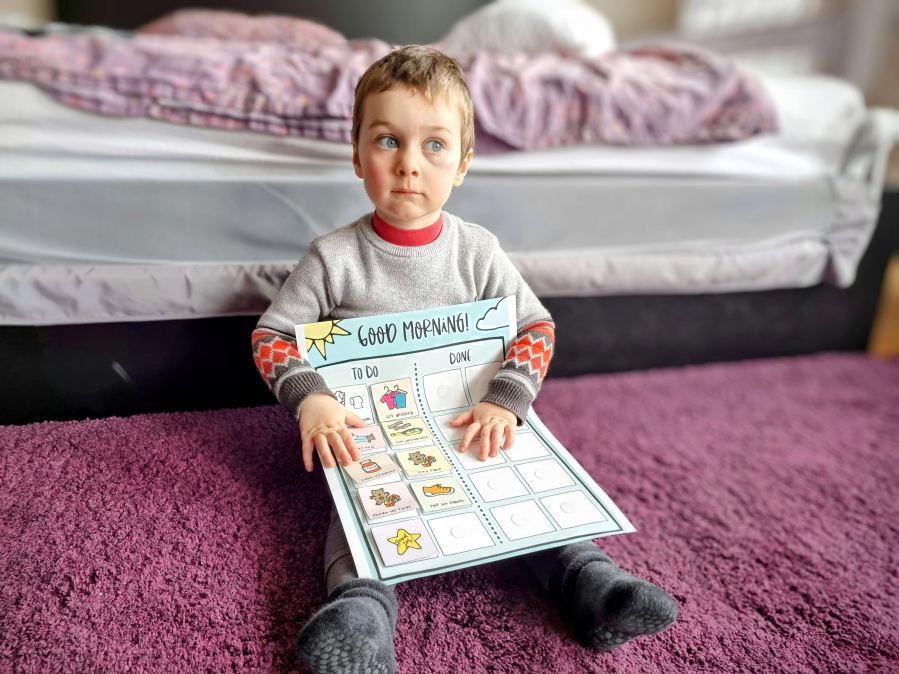
Instead, we can create a structure which acts as a backbone, guiding the rest of the variables. This is the goal of an effective routine, which is why morning and evening routines are so powerful and useful, especially with kids. Everyone knows what needs to get done and the (rough) sequence of activities–that’s the backbone that brings the activities in line.

The key to an effective routine is to be flexible in order to allow for variation. I know that sounds like an oxymoron–a flexible routine?! But this is the only way for a routine to be useful day in and day out.

A simple way to make a routine flexible is to allow for extra time. Let’s say you’ve timed your family’s morning craziness (ahem, routine), and it usually takes you around 1 hour and 10 minutes to get ready and out the door. When you do your planning, consider your morning routine to last 1 hour and 20 or 30 minutes, depending on how many people are getting ready (2 vs. 4, for instance; each added person brings in a larger degree of variability). This allows for things to go differently from how you planned: your child may be grumpy, someone may need to poop even though they don’t usually poop at that time of day, or someone may forget something (a backpack, a lunchbox, keys…). Let’s allow for things to go wrong in our system, so we aren’t thrown off course once something inevitably doesn’t go as planned.

Also, the sequence of things may need to be switched sometimes. For instance, if our baby wakes up at the same time as I do, I may feed her first and then get dressed, wash my face, etc.; if she sleeps a little longer, I’ll swap these two things around. Sometimes, our son wants to get dressed right after getting up, and other times he wants to eat breakfast in his pajamas. We allow for that flexibility on purpose because it makes him feel like he has a choice in how the morning routine unfolds. The truth is that he has a choice regarding some things and not others (most things, in fact), and it’s helpful in reducing tantrums to emphasize when he does have a choice. Similarly, he doesn’t get to choose all of his clothes because what he wears is weather-dependent, but he gets to choose his shirt (“Do you want a shirt with one dinosaur or three dinosaurs?”) and his socks (“Do you want socks with green, blue, yellow, or red dinosaurs?”). You have probably noticed we are in a dinosaur phase!

Chaos, unpredictability, and variability are inevitable in any life circumstances and certainly in family life. Our best bet is to embrace chaos, to count on things turning out differently from expected. At the same time, we can have systems in place that prevent things from falling apart, so the important things can still get taken care of.

Our baby is 4 months old!

Julia, our baby daughter, will be 4 months old tomorrow! Crazy! It feels like she is still a newborn, but she’s really not…

Our summer was full of events! I was very (VERY!) pregnant in June, then Julia was born, and from then onwards we had long days and nights of caring for her and enjoying her cuteness.

Slowly, the warmth of summer turned into the coolness of autumn, and I mean it when I say slowly–we had some very warm October days here in the Netherlands. We’ve settled into a little bit of a rhythm with Julia and William, her older brother. There are still many tantrums and cries around here, but there are also many lovely moments.

As Julia is turning 4 months, she is settling more into a rhythm and is becoming more comfortable in the world. We’re also more used to her and are better able how to soothe her, so she can enjoy her surroundings.

We have another big transition coming up: William is turning 4 years old, which is when kids in the Netherlands go to school! He’ll be saying goodbye to daycare and starting at school in less than a month. He’s quite excited for it, but I am quite nervous about it! Will the other kids be nice to him? Will the teacher be kind? How will he feel there? A mother’s heart worries about all the possibilities, I guess…

William’s starting at school means a change in the family routine as the starting and ending times of the school day are different from those at daycare. We’ll see how those will combine with Julia’s nap times–you can imagine 4958 permutations have gone through my mind. I’m sure we’ll adapt just fine, but often the anticipation is worse than the reality.

In a nutshell, life has changed quite a bit for us in the recent months, and it will keep changing. As the saying goes, change is the only constant, right?

Can I do nothing on my birthday?

A couple of weeks ago, it was my birthday. I started planning the day a month in advance, and I was really looking forward to it. I was planning to take the entire day off work and only do relaxing and enjoyable things.

The Birthday Plan

In the morning, I’d get a massage. I looove a good massage.

Then, my husband and I would have a relaxed, romantic lunch together.

Afterwards, I’d go to a café, drink some tea, eat some cake, and read my book. By myself!!! Two hours for me with my book. Pure indulgence!

Continue reading “Can I do nothing on my birthday?”

Exercising in the middle of the day?!

I’ve been experimenting with something kind of crazy lately: exercising in the middle of the day. What?! you might say. People usually exercise in the morning or the afternoon (although there are those who exercise in their lunch break instead of having lunch). I usually also prefer the afternoon for exercise, but hear me out…

Recently, I experienced some neck and back issues that tended to get worse the longer I remained sitting. Now, I work at my desk, so that’s kind of unavoidable. “How can I break up the periods of sitting?” I wondered. I began by looking at what my typical day looked like: identify the problem.

A typical day

Here’s what a typical day looks like for me. In the morning, I walk to daycare with William and then back home. It’s nice to start the day with a walk outside, and I’m glad I have this opportunity. Then, I come home and sit at my desk for the whole morning. I take brief breaks, but in the end I still spend about 3 hours sitting.

Continue reading “Exercising in the middle of the day?!”

My morning routine

The previous evening sets us up for the day ahead. I described extensively what I do on a typical evening here, and now I’ll talk about my mornings.

The funny thing is that my morning routine is much shorter than the evening routine. The latter is elaborate, with many moving parts, while the former is rather straightforward. Anyway, I’ll walk you through it.

Wake up 30 minutes before my son

This has been key. I used to wake up at the same time as William, and that felt stressful even though I didn’t realize it so explicitly. I was trying to take care of his needs while also taking care of my own, which often led to frustration on both sides: he wanted me to cuddle him, but I just wanted to pee!

Continue reading “My morning routine”

My evening routine

A good evening routine would set me up for a restful night of sleep and a good next day.

I wanted to create a realistic and stress-free (as much as possible) evening routine, so I had to leave enough time for everything I wanted and needed to do. I hate to be pressed for time in the evening when I’m tired and trying to wind down! Sometimes it still happens, and it’s oh-so annoying.

My evening routine starts early

I figured out that the evening routine starts as early as 17:00 (5 pm) when I leave to pick up William from daycare. I could pick him up anytime before 18:00 (6 pm), but if I leave later than 17:00 (5 pm), I just end up being too late for everything else, and I then have to rush. So I do my best to finish up my work, get ready, and leave on time.

Continue reading “My evening routine”

Your morning routine starts the night before

Ah, this is so true! How your morning goes depends to a large extent on what your evening looks like.

Do you go to bed at a time which allows you to get enough sleep?

Have you prepared yourself for the next day (e.g., clothes, food, backpack, living space)?

Have you made a plan for the next day?

Continue reading “Your morning routine starts the night before”

My theme for the year: Go Easy

I’ve chosen my theme for the year: Go Easy!

I was inspired by Adele’s song Easy on Me. In my case, I need to go easy on myself.

I don’t really like going easy. I’m good at going hard and pushing through until I get results. This approach has worked well for me for a while.

Recently, I had a serious neck problem and frequent headaches, and I’ve been unable to get good sleep, which just made me more tired overall. Therefore, I had to really slow down and rest. It’s not nice, but it had to be done.

The truth is that I don’t like resting very much. It’s boring! What’s so enjoyable about lying there and doing nothing? I want to be doing stuff, to be excited, and to be experiencing new things. I don’t like being bored. (Or maybe I’m just doing resting wrong? Let me know.)

But I’ve heard of countless successful people who pushed too hard, had a burnout, and then had to reinvent their lives. I didn’t want to do that. Burnout may be inevitable sometimes, but I was actually aware of the fact that I needed to slow down before things became fully disastrous. With awareness and knowledge comes responsibility, so I sighed deeply and actually started taking breaks…

Over time, my neck problems and my headaches have begun to subside, but I still need to remember to take it easy. It is too easy to forget and go full speed again, only to hit the same roadblocks again.

Another trick I’m aiming to implement is to allow for transition time between activities. Often I run from one activity to the next, making sure my day is maximally productive and jam-packed. But that means I tend to be stressed about running late and cannot allow myself to take an extra minute or two if needed.

Unfortunately, this means I may be snappy or irritated with my closest people, usually my husband and my son. This isn’t nice for anybody, and I’d rather be more at ease in order to bring a more peaceful energy to our home.

So I’ll try to build in transition time (5 to 10 minutes) between activities as well as underplan my day as a whole. Think I can do these three tasks in an hour? Plan on doing two. Expect this task to take two hours to complete? Plan for two and a half.

As much as I don’t like going easy, that is what I’ll be aiming to do this year. I’ll allow myself time to rest, I’ll underplan my days/weeks/months, and I’ll allow for transition time.

Let’s give it up for going easy!

From the idealistic to the pragmatic: Priorities -> Goals -> Tasks

In the previous two weeks, I wrote about identifying your unique priorities and creating goals in order to make those priorities a reality. Now, it’s time to get very specific and identify tasks that will allow you to reach your goals, so you can live according to your priorities.

Once you identify important goals in your life, it’s time to break them down into actionable steps. What tasks can bring you closer to your goal?

If you want to learn to play piano, a suitable aim may be to play piano 3 times per week for 30 minutes. If you want to spend more time with friends, you can make it a goal to meet up with a friend for dinner or lunch once a week. Then, go ahead and make arrangements with your friends to that end. The key here is to make the steps actionable, so it’s clear what you need to do to move closer to your goal.

Next, you should put the action you’ve identified on your calendar and/or to-do list. Put it somewhere where you won’t forget about the activity, you’ll be reminded of it, and you’ll be able to review it. My calendar and my to-do list (both digital) are my best friends in this regard because they are always by my side (on my phone).

It’s very important to be practical and to plan your activities in detail. Multiple studies have shown the “when, then” approach extremely effective in modifying behavior: for instance, “when I come home from work, I will play piano for 30 minutes. Thus, identify when exactly you will do your new behavior, and decide on what exactly you will do. Be as specific as possible.

We should aim to break down our big goals into small, manageable steps and plan when and how we will carry those out. This is the way to make our goals happen.

Be specific with your priorities: Set goals

Last week, I wrote about how you can identify what’s truly important to you in your life. Now, let’s get specific, so we can make your vision a reality.

Now that you’ve reflected on the main categories of your life, we’re going to set goals to reflect where you’d like to be regarding each category.

In some of these areas, you may already be living life as you’d like it to be, and in other areas, there may be a mismatch between what you’d like your life to look like and what it currently is. In this exercise, you’ll gain awareness of where you are now and where you’d like to be.

  1. What goals and projects (activities, responsibilities, things you do) do you have in each category?
  2. Do you feel fulfilled by the combination of goals and projects listed here? Does the list feel “complete”?
  3. In an ideal world, would you remove any goals and/or projects from this category, i.e., would you take anything off your list?
  4. In an ideal world, would you add any goals and/or projects to this list? Is there anything that you feel is missing that you’d like to add?

Run through this exercise for each of the 10 priorities categories. You’re finished when each category feels fulfilling to you.

Now, try to take in the 10 categories together. Do they make for a fulfilling, purposeful life? It may be difficult to hold everything you’ve written in mind at the same time, but allow your gut feeling to guide you here. Does your intuition tell you something is missing? Or does this feel like a pretty good life?