Gastritis Post 4: What worked for me Part 1

Finally, I’ve gotten to the most intriguing part: What worked for me in treating my gastritis? I will dive right in.

The main thing is actually quite simple and it blew my mind that it had such an influence:

  1. Keep blood sugar levels stable: eat enough protein and healthy fats and not too many carbohydrates.

Since with gastritis my stomach hurts when I’m hungry, it really helps to keep my hunger signals under control. For that, it is helpful not to spike my blood sugar. I was extremely surprised to discover how big of a deal this was, but it makes a huge difference!

I used to eat oats with yoghurt and fruit for breakfast, and I’d be in pain 2 hours later. Then I’d have a muesli bar and my stomach would be hurting again 2 hours later. For lunch I’d have a sandwich and a salad, and 3 hours later I’d be in pain again, so I eat some fruit for a snack until I can barely wait for dinner because of the pain. And this happened every day…

Now I eat scrambled eggs with vegetables (usually zucchini, leeks, and portobello mushroom) and a little butter for breakfast and I’m only hungry 4 hours later. The important thing is that I am actually hungry then and not simply in pain. Then I eat lunch which is, again, protein with vegetables and some healthy fats. For instance, chicken with cauliflower and carrots or meatballs with broccoli and usually some olive oil. This keeps me feeling good for another 4-5 hours. I usually have a small snack at that point such as a small avocado with almonds or brazil nuts or canned sardines with a cucumber. Then, for dinner I also have a mixture of protein (chicken, beef, salmon, or catfish), vegetables (e.g., cabbage, pakchoi, spinach, kale, broccoli, cauliflower), healthful fats (e.g., ghee or coconut oil), and if I’ve had a training session I also include starchy vegetables (e.g., sweet potato, pumpkin, beets, carrots, parsnip). With all of these foods I include a variety of spices and herbs.

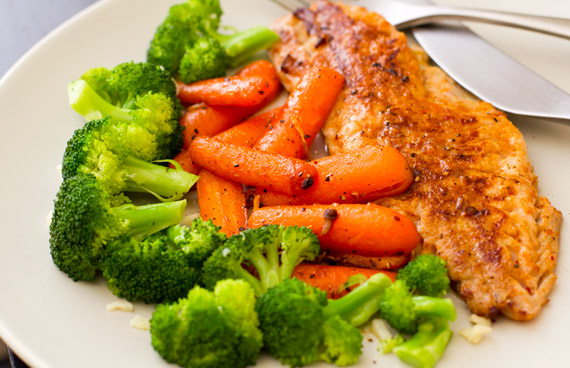
Basically, my breakfast every day. And I don’t get tired of it.

Image source: I Health U

This eating style keeps my blood sugar levels stable, so I don’t get any peaks and dips. This means that I don’t have fits of stomach pain between meals and I can go for normal periods of time without eating instead of having to eat every 2-3 hours. I still don’t eat huge meals because I don’t feel comfortable when I’m bloated from too much food. I also find that eating until I’m 80% full helps me keep my weight at a level I like. In fact, I’m quite lean now without starving myself, and I get to enjoy my food very much.

The reason this works so well for me (and for many other people) in keeping my blood sugar levels stable is that the macronutrient content is balanced. Protein is very satiating (makes you feel full for a long period of time), so it’s good to include it at every meal in order to avoid sugar dips. Fat is also very satiating, but it’s also high in caloric value, so it’s good not to overdo it. Healthy fats are essential for our health though, so don’t avoid them.

Carbohydrates are a little more questionable. Different types of carbohydrates work differently for different people, so it’s important to figure out what each type of food does for you. But generally simple sugars (sweets, sodas, etc.) spike our blood glucose levels and thus lead to a sugar dip afterwards. This is also true of many fruits (e.g., banana, mango, raisins, any fruit juice). Bread and pasta can also have that effect, although there’s more individual variation there. It’s also important to get good nutritional value out of the carbohydrates we eat, and the best way to do that is to eat starchy vegetables (e.g., sweet potato, pumpkin, parsnip). They contain the carbohydrate that is good for the body especially after intensive physical activity, and they also deliver lots of fiber, vitamins, and minerals. Moreover, when combined with protein and healthy fats, starchy vegetables don’t spike our blood sugar so much, so we can enjoy a meal containing some carbohydrates without having to suffer a sugar dip.

The main point here is that when I keep my blood sugar levels stable, I don’t get sugar dips, and I don’t experience the intense hunger which triggers my gastritis. In this way, my stomach doesn’t get irritated, so I’m not in pain.

This doesn’t mean that I never eat sugar. For instance, I eat dessert twice a week, and that works great for me: I don’t suffer from sugar dips and intense, painful hunger often, but I still get to enjoy sweet stuff once in a while. The key is that I usually have it after a main meal, so then it doesn’t trigger a blood sugar spike and a consequent dip, so I’m not in pain. Some people do well having sweets once in a while, but for some people it might be easier to give them up altogether. (See Gretchen Rubin’s distinction between abstainers and moderators.) You can try it and figure out what works best for you.

The kind of food I’ve described here is the first and most important thing that helped me heal my gastritis. In the next blog post, I will describe the other 14 things I discovered!

Source of featured image: Eat Drink Paleo

Gastritis Post 3: What didn’t work for me

Since I developed gastritis, I went to several doctors to ask for advice and medications. I went to my GP, to a gastroenterologist, to an expensive private practice which ran fancy tests, and to a homeopath. They all reached the same conclusion: you have gastritis.

I was told to eat every 3 hours, mostly rice and potatoes. I did that for a couple of weeks, but it only made me hungry the whole time and didn’t particularly help my gastritis.

I was given medications that suppress the production of stomach acid, specifically Nexium (esomeprazole). They made the pain less intense, but if I skipped a dose, I noticed how bad my gastritis actually was. I took Nexium for 2 years, but my symptoms didn’t disappear. At that point, I got worried because there was mounting evidence that acid-suppressing medications decrease bone density and contribute to hip fractures once people get older. This has only been shown for long-term users of such medications, but 2 years seemed close to long-term to me. I gradually weaned myself off of Nexium and stopped taking it altogether.

Afterwards I found out that an important consequence of taking Nexium for a long time is that minerals and vitamins are not absorbed well by the digestive system (apparently, stomach acid is necessary for that). The most common issues are low levels of magnesium, calcium, and vitamin D, which lead to decreased bone density and more fractures in the hip, spine, and wrist. B12 deficiency is also common. Honestly, I’m glad I’m not taking Nexium anymore.

Many of the doctors who saw me were convinced I had an H. pylori infection, so I got tested several times over the years. I kind of wished I had the infection because then I could have just taken an antibiotic and been done with it. First, my GP ordered a blood test, which was negative for H. pylori. A few years later, since I was still struggling with gastritis, he ordered a fecal test because that was more accurate than a blood test. Unfortunately, that was negative too. A few years later still, the gastroenterologist said that the most accurate test for H. pylori was a gastroscopy, so I had that done as well. Very unfortunately, since a gastroscopy is quite unpleasant, I had no H. pylori. The doctor confirmed that I had gastritis though, to which I said, “Well, thanks very much for the news.”

I almost wish I had an H. pylori infection because then the course of treatment would have been clear. But I didn’t have it.

Image source: El Ombligo del Ocio

The homeopath I visited was very pleasant and reassuring and actually told me that the traditional methods I was trying (such as the anti-acid medications) would not heal my gastritis. In the end, he was right, but unfortunately the treatments he gave me didn’t get me better either. So traditional medicine didn’t help me heal, but homeopathy didn’t either.

To sum up, the typical approaches to treating gastritis didn’t help me heal. I ate every 3 hours, mostly rice and potatoes, I took acid-suppressing medications, and I got tested for H. pylori, but those things didn’t help. In the next blog post, I will cover what actually helped me to get better.

Source of featured image: Static Flickr

Gastritis Post 2: How I got gastritis

I got gastritis at a time when I was dieting too forcefully, drinking too much alcohol, and experiencing too much stress. On top of that, gastritis runs in my family.

As a typical 16-year-old girl, I decided I wanted to lose weight, so I went on a diet. In fact, I had gained 4 kg during summer break, so I had gone from 55 kg to 59 kg at the height of 164 cm. It shouldn’t have been a big deal, but I thought it was. So I went all out: I made my meals about half of what I used to eat, and when I invariably got hungry between meals, I ate apples or cucumbers. It often happened that I was ravenously hungry when going to bed around 10pm (I ate a small dinner at 5pm), so I’d have half a cucumber. Oh, what an indulgence!

On the weekends, things got even more intense. I usually skipped dinner on Friday and Saturday and drank hard liquor instead. I noticed that I didn’t feel hungry then, so I just kept partying without the need for food. My favorite was the morning after a party when I’d get up and weigh myself (yes, I was weighing myself everyday at that point): the number on the scale was often 1 kg less than the day before, and I felt such a sense of accomplishment! Little did I know that that was mostly dehydration and I shouldn’t have been surprised to see most of that come back the next day.

So I combined intense dieting with alcohol, and both irritate the stomach lining and contribute to gastritis. I was also working very hard at school, experiencing lots of stress. I didn’t sleep enough and I exercised a lot (about 1.5 hours five times a week, also as a consequence of my weight loss goals). The high workload, the sleep deprivation, and the excessive exercise all led to lots of stress. And stress also leads to gastritis.

Constantly hungry…

Image source: Collective Evolution

After about 6 months of my forceful dieting, I had almost reached my goal: I was 51.5 kg after having started at 59 kg. I had wanted to get down to 50 kg, but I felt that what I was doing was unsustainable. So, thankfully, I decided to stop at 51.5 kg. I went out and celebrated and bought new jeans. Afterwards, I started eating a bit more, but I was still restricting myself. Eventually, I went back to about 55-56 kg (which was also where I was before I gained those 4 kg after summer break). My body went back to the weight that was normal for it, so in the end my dieting didn’t really have an effect. No surprises there.

The only real effect was that now I had gastritis. I felt sharp pain in my stomach whenever I was hungry, and I had to eat immediately. I had my meals carefully planned out, and I got irritable and upset if a meal was delayed. This gave me extra stress because I was constantly thinking about when I would eat next, so I don’t feel pain but also so I don’t eat too much and end up gaining weight. For more details on my struggle, read my previous blog post.

As I spoke to people about gastritis, I found out that more people had it than I had expected. Almost everyone around me knew what it was and had either had it themselves or knew someone who had it. Most importantly, many of my family members had had it: my mother, her brother, and her father, as well as my grandmother on my dad’s side of the family. A few years later, my cousin developed gastritis and my brother had it for a while as well. It became pretty clear to me that gastritis ran in our family, and apparently I was genetically predisposed to it.

You may have noticed that I referred to some of these people as having gastritis in the past tense. Yes, they didn’t have it anymore: somehow, they had healed. Interestingly, when I asked them how they managed to get rid of their gastritis, they couldn’t tell me exactly. They all had their horrific stories of unbearable pain, but after a while it just disappeared on its own. They hadn’t really noticed how their stomachs had healed, but they had. It appears that for some people gastritis is acute and it heals once the irritating stimulus is gone, while for others it’s a chronic condition. I was definitely in the camp of those for whom it was chronic (12 years…).

To sum up, in my case several things combined and led to gastritis: dieting, alcohol, stress, and a genetic predisposition. (Note that I didn’t have an infection, but for other people that can certainly contribute as well.) Now that I know more about gastritis, I am not particularly surprised that I developed it given those things. Still, I wish it was easier to heal it. In my next blog posts, I will describe what I tried as medications and remedies (and there’s a lot!) and what actually worked.

Source of featured image: Medical Daily

Gastritis Post 1: My story with gastritis

I’ve had gastritis for more than 12 years now, and it’s finally healing. I find it hard to believe that I’ve gotten better, but it’s true. And I’d like to share with you how I’ve managed to do that.

I’ve tried multiple treatments and remedies, without success. Now I’ve finally found something that works, and I’d like to share that with you.

Having gastritis became normal to me. I was used to eating small portions of food 5-6 times a day. I would have a meal, feel alright for about two hours, and then double over with pain. I could barely wait for my next meal which gave me a brief relief until two hours later I was in pain again.

This made it difficult to lead a normal life. I carried food everywhere and felt weird for having to eat at very (very!) specific times. Eating a meal 15 minutes later than planned was a problem. 30 minutes later was impossible. 1 hour later was unthinkable.

I got irritable if I had to wait for a meal, perhaps understandably because I was in pain. The people around me were stressed out when planning meals with me because they knew I might get upset if a meal began 15 minutes later than expected.

I was also stressed out because: 1) I was afraid I might be in pain, 2) I was afraid other people were getting annoyed with me, and 3) because I was afraid of gaining weight. You might not see how 3) is related to having gastritis, so let me explain.

Since I was eating 5-6 times a day and I saw other girls eating much less, I was afraid I was eating too much. Thus, I tried to make these meals small. I thought that since I will need to eat in 3 hours anyway, I should eat a little bit because otherwise I’ll end up eating a lot during the course of a day.

I was told that small, frequent meals would help my gastritis heal.

Image source: Mind over Munch

Also, if I had to wait for a meal and I was in pain, people said, “Well, why don’t you just have a snack now?” What people didn’t understand is that I wanted to minimize the amount of food I was eating. An extra snack here 30 minutes before dinner was too much food according to my thinking. So I’d try to wait until dinner instead of having a snack. This made me extra irritable because of the pain and in the end if it hurt too much, I’d have a snack anyway. This led me to be even more annoyed with myself since now I was also eating more than I had planned.

Living this way is not pleasant. I experienced a constant fear of hunger and tried to incessantly plan when I would eat what. This helped when I was able to follow my plan, but it led to stress when circumstances made it impossible to follow my plan exactly.

During my 12 years of having gastritis, I tried multiple medications and remedies. I went to several doctors and followed their prescriptions. I also consulted homeopaths, naturopaths, and grandmas who have me home remedies. I read a lot online and tried different things. Some of the suggestions I received helped briefly but didn’t lead to actual improvements. Others genuinely made my condition worse.

Now I’ve finally found something that works. I have been doing this for about a year now, and I am over the moon with joy that I am finally healing my gastritis! I have been able to return to regular eating habits and to be less scared of being hungry. I eat 3 meals a day and a small snack. I can manage if a meal happens 30 minutes or 1 hour later than planned. I can barely believe it! I actually get hungry now instead of just being in pain. This may sound silly but it feels so good to feel normal again.

I’d like to go over my whole journey with you: I’ll tell you how I got gastritis and how it affected my life. Then I’ll tell you what I tried but didn’t see improvements and why you shouldn’t try this. I’ll go on to tell you what actually works! I’ll also discuss the things I tried that didn’t work for me but might work for you. Finally, I’ll also discuss the unique role of stress in this whole thing.

Image source for featured image: ltkcdn.net