The Getting Things Done approach

The question still stands: what is the best way to tackle a task? In other words, what do you do when a task comes your way? The Getting Things Done system by David Allen offers a simple and practical approach to this.

From Getting Things Done by David Allen.

When something comes in on your plate, you need to ask the question, “What is it?” and “Is it actionable?” or in other words, “Can I act on this?”

If it is actionable, you need to ask, “What’s the next action?”

If the next action takes less than 2 minutes, you need to do it now. This may sound strange, but it is immensely helpful. If you do quick tasks immediately after they come onto your plate, you make sure you don’t get drowned in small to-do’s later. I often make sure to send that email now instead of leaving it until later. It takes so little time and is a huge load off my mind.

If the task takes more than 2 minutes to complete, you can try to delegate it. Not all tasks are suitable for delegation, but if it is, that’s a great option. In that case, you can email, message, or call the person to inform them of the task. Crucially, after you’ve done this, you need to make a note of it in a “Waiting For” list or under the project heading where the delegated task belongs. We often forget what we asked someone to do for us, and things can sometimes slip out of our control when we delegate them to someone else. That’s why it’s useful to have a way to keep track of what we are waiting for from someone else.

If you can’t delegate the task and you can’t do it right now, you can defer it to a future point in time. You can put it on your calendar, so you will do this task on a specific date and time. For example, I will wash my car on Saturday at 10:00. I don’t have to do it now, but I know it will get done.

You can also put it under a project heading (i.e., in the list of tasks belonging to a certain project) for you to do as soon as you can. This means that you don’t have to do the task on a specific date and at a specific time, but you will get to it when the time comes.

Every time you work on a certain project, you revisit your list of tasks for that project and tackle the task at the top of the list. In this way, you know that the tasks you put on there will get done and won’t be forgotten. Let’s say you want to change a light bulb in your house. You don’t want to do it now and there isn’t really a deadline for when it needs to get done. So you put it on your list of Home tasks. Next time you’re at home and have some time to do housework, you can take a look at your list and change that light bulb.

If the task that comes your way consists of multiple steps, then it may in fact be a project. If it is a project, then make a separate project heading for it with a list of tasks under it. If it’s smaller than a project but requires multiple steps, you can put the task under your already-defined project heading and include a list of sub-tasks that need to be completed. Then you treat each sub-task as described in the previous paragraphs and either do it, delegate it, or defer it.

Let’s say you want to buy a new washing machine. It’s not quite a project because it’s not that big (it belongs to the Improve Home project), but it’s a multi-step task. I’d identify the following sub-tasks: look for washing machines online, pick 3 washing machines, go to a store to see them, order a washing machine, install the new washing machine, remove the old washing machine. Then I would schedule “look for washing machines online” on my calendar and proceed from there.

If the task is not actionable, i.e., you can’t act on it now, you can include it as a reference. This means you can look at it later when/if you need to. It’s good if such a folder or system is organized by topic or is searchable in order to facilitate easy discovery of materials. I often use this for interesting articles, videos, web pages, etc.

Alternatively, you can incubate the task or idea as a possible later action. It’s nice to have this collection of possible later actions, for instance, for future work projects, trips you could take, or books you’d like to read.

Finally, you can consider deleting the incoming task. If it’s not important or interesting enough to end up in your reference materials or in your possible future actions, then it’s probably fine to just delete it.

This is a brief summary of the Getting Things Done system. It offers a practical approach to any task that might come your way and while in reality it may not always be easy to decide which category a task belongs to, you can always ask yourself the right questions, make a choice, and enter the task in your pipeline. In this way, nothing slips through your fingers and you end up tackling tasks one way or the other.
Dealing with tasks

Now that you’ve broken down your priorities all the way down to tasks, how do you deal with those?

Let’s take one task as an example, for instance, washing your car. This is not the type of task that can be done immediately because it takes a while. Therefore, you should schedule it. Ask yourself the following questions: When does the task need to be done? Perhaps before your parents come to visit next month. When is a good time for you to do the task? Next Saturday morning could be a good time. You can go ahead and put that in your calendar.

Tasks can get scheduled on your calendar or they can be put on a to-do list, possibly with a reminder. The important thing is to actually check your calendar and your to-do lists. Otherwise things go on there but never get done.

Here comes the important part: actually doing a task. At the beginning of the day (or several times a day), you can check in with your calendar and your to-do lists. Let’s say it’s 8:50 on a Tuesday morning. What activity is scheduled for 9:00 on your calendar? Or if you have an hour of two of time for general work, what tasks are on your to-do list for today or for this week?

By going through the tasks you’ve already outlined for yourself beforehand, you make sure that you’re completing tasks you’ve outlined as important earlier. You don’t have to make the decision now about what you need to do. You’ve already made that decision beforehand, and by taking action now, you know you’re making progress towards your goals and that therefore you’re living in accordance with your priorities.

After you’ve completed a task (or a group of tasks), you can review your progress. I usually do this once or twice a day, typically at the end of the day. I look through the tasks I’ve completed today and remark on the progress I’ve made on my projects and thus towards my goals. Even if I’ve worked on very small, specific tasks during the day, I can evaluate exactly how those fit within my overarching goals. This brings perspective, reminds me why I’m doing what I’m doing, and reassures me that I am respecting my priorities.

On some days, things don’t go exactly as planned, and at the end of those days I don’t usually feel like doing a daily review. It feels like the day has been a mess, so I just want to leave it behind and get on with my life. In fact, every day includes something that doesn’t quite go according to plan. But that’s all the more reason to do a daily review: What actually happened today? How did it differ from what I had outlined for myself today and why? What forced me to adapt my plans? For instance, if a request comes in from a colleague, I have a choice about whether to tend to it right now, to put it on my to-do list, or to schedule it for a later date. If I choose to do it right away (and the request is not urgent), that may mean that I am overly eager to serve other people instead of sticking to the tasks I have prioritized. Or it may mean that I am anxious about the project I need to work on and prefer to procrastinate by doing other work.

It is extremely useful to examine those differences between the “ideal” day, as planned beforehand, and the actual day that ends up happening. What are the differences and what tension do they stem from? Do you have unrealistic expectations for yourself; do fake emergencies come your way too often; is there a priority or project that pops up but you haven’t accounted for properly; are you overwhelmed or anxious about a project you’d like to tackle; do external circumstances derail you?

If you stop to think about what unwanted factors are influencing you, you will be better able to avoid their influence next time. And in that way it will be easier to actually do the tasks you wanted to do in the first place.

Get more specific: Priorities to Goals to Projects to Tasks

Once you’ve set your priorities, you need to make sure you’re living in accordance with them. To do that, you need to make your priorities actionable. But priorities are by definition at the big picture level. How are we supposed to make them small and action-sized?

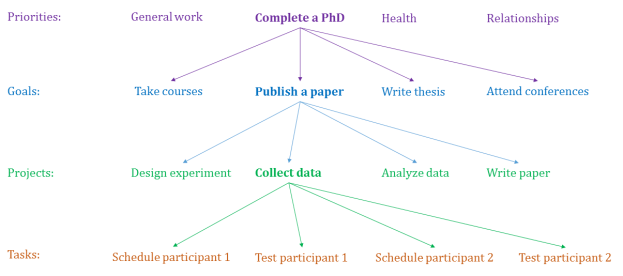
The way to do that is to break down your priorities into goals, your goals into projects, and your projects into tasks. In this way you know that when you complete a task, it completes a part of a project, which fits into a goal, which supports your priorities. If you follow this scheme, even the small actions you take will be feeding into your goals and making sure you’re living in accordance with your priorities.

Often when we are engaged in a small, everyday activity, it can feel meaningless or boring. We lose perspective (why am I doing this?) and do the activity just because we have to do it. But if we follow this framework, no matter how small the activity, we can easily link it to our projects, goals, and priorities, so it quickly fits into our overview of our life and where we’d like to be.

For instance, if I am sitting in front of my computer and renaming files, it can get boring very quickly. But if I remember that I am doing this because once the files are renamed, I can analyze my data and find out the answers to interesting questions I’ve posed in my research, suddenly I know why I am renaming those files and feel more motivated to keep doing it.

Or if I am at home, standing in the kitchen and cooking for two hours, I may feel annoyed and may want to stop. But if I remind myself that I am preparing healthy food that will support and heal my body and ultimately help me to lead a more vibrant life, I may find myself suddenly energized and willing to cook.

What does it actually look like to break down your priorities into tasks? I will give an example from my own work. A priority of mine is to complete a PhD. One goal that belongs to that priority is to publish a paper. One project that belongs to that goal is to collect data. One task that belongs to that project is to schedule the participation of participant 1.

Priorities -> Goals -> Projects -> Tasks

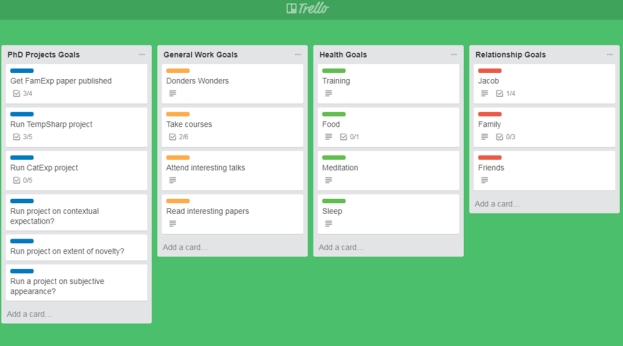
It’s very helpful to have an overview of your priorities, the goals that you currently have for each priority, the projects that belong to each goal, and the tasks that belong to each project. This makes it easy to see how far you’ve progressed on a certain project or goal and how this fits with your priorities overall.

Here is an example of some of my goals and how I’ve divided them according to priority. Each goal contains a list of projects or simply tasks.

Your Priorities

I often wake up to a list of to-dos. From the moment I open my eyes, I am running around: quickly, shower, eat breakfast, get dressed, rush out of the door, don’t forget anything! All the things that need to get done today hang over my head like ominous red lights. Will I make it through today? Will I complete everything? Or will some unexpected obstacle come up and make my day explode into pieces? Once the evening comes around and (hopefully) I have time to relax, I am exhausted. I can’t enjoy my free time because my head is spinning with worries, and I can’t be warm and caring towards my loved ones because I’m drained. Even though I’ve done so much today, what difference does it make? This is hardly the life I want to live. This is not how I want to feel.

You might think that in order to change the way you feel and the way you live, you’d need to make a big change: quit your job, move to a different house or city, leave your current relationship, etc. It is appealing to escape our current life and all its troubles. It’s easy to think that the problem lies in our job, living situation, or other people, and it’s tempting to get rid of all our worries and troubles by getting rid of one specific thing. We imagine that we’ll be so much happier if only that one thing is gone from our lives.

Unfortunately, that doesn’t work. You are you, and your worries and troubles will come with you even if you try to escape. The uncomfortable truth is that the big problems are not outside of us but rather inside us. Escaping them is not possible. Instead, we need to find a way to deal with them.

One of the biggest issues is that we walk around feeling unhappy, expecting that the world around us has to make us happy, and when it inevitably fails to do so, we complain and blame. We don’t take the time to think about what we want and what would make us happy because that’s way more difficult than blaming our unhappiness on somebody or something else. And even if we do think about what would make us happy, we don’t do anything about it or we have unrealistic expectations.

But there’s another way. We can carefully reflect on what we want and observe what makes us happy. These things are often much simpler than we imagine. We don’t need the most exciting, amazing job ever or the most romantic, perfect relationship. Instead, we need to figure out what is good enough for us and learn to appreciate it. This is easier said than done, so a good way to approach it is through trial and error: try something and see if it makes you happy. Observe. The important thing is to stay inquisitive and intentional. After you try that thing, does it make you happy? Does it fulfill the purpose you had in mind? Does it give you the meaning you were looking for? Does it inspire you?

You’ve probably heard about priorities before. No, not this kind of priorities.

In this way, you can find out what your priorities are. Your priorities are the main things that matter to you in life, and they guide everything you do. Often we think of priorities as vague things: career, family, friends, health. But if you want your priorities to really guide your behavior on a daily basis, they need to be more specific. “Work” might become “Complete a PhD program” or “Become an independent researcher.” “Relationships” might become “Be close with the people I love.” These specific priorities may change over time, and that’s okay. In fact, they should change, so they reflect what’s important to you at different stages of your life. In this way, you feel connected to them, and they truly guide your actions. It’s best if you write down your list of priorities and review it often.

This is a list of priorities that is way too vague.

Make sure each priority is specific and inspires action.