The Art of Doing Nothing

We’re very good at being busy and running around, but do we ever manage to stop and truly do nothing?

I recently came across a cool idea: the Art of Nothing by Dr. Alessandra Wall. It’s the simple suggestion to take some time every day to do nothing. Yes, yes, I thought, I know that’s important. But I don’t have time to do nothing.

Most days, we’re running around from thing to thing, rushing and not stopping until the end of the day when, finally, we plop down on the sofa, exhausted. When we do take a break in the evening, we watch TV, check the messages on our phone, scroll through social media, or read a book. We rarely take the time to really and truly do nothing.

Dr. Alessandra Wall argues that having time to do nothing allows our thoughts to wander and make connections, so eventually we can make sense of what is happening in our lives and realize where we’d like to go from here. She makes the point that without such time to gain clarity, we are mostly floating along and may end up in a situation (e.g., job, relationship, etc.) that we wouldn’t have necessarily chosen for ourselves. The feeling of, “This is not the life I wanted,” “How did it come to this?!” or “This is not who I am!” may be resolved if we sometimes let our minds wander, so we can reflect and make sense of the events in our lives.

How to practice the Art of Nothing?

Since I’ve been meditating for years, this idea immediately reminded me of meditation. The similarity is that both meditation and the Art of Nothing provide a way to observe your thoughts and reflect on them. Also, both approaches emphasize sitting down and taking a moment to be present and notice what’s going on.

The difference is that meditation is much more structured and feels goal-oriented (even though ideally it shouldn’t be). When meditating, there is a certain technique we’re using or instructions we’re following. It’s difficult to feel like we’re having a good meditation session because thoughts inevitably come up and distract us from the focus of attention or, in other techniques, the open awareness we’re maintaining. Even if our meditation teacher has told us multiple times that it’s okay and perfectly normal for the mind to wander, we still often feel that we’re supposed to avoid thoughts.

It struck me how different the Art of Nothing felt in that respect. Basically, you plop down on the sofa and let go. Many thoughts will come to mind, and that’s the whole point. You’re not telling your mind to be still or to focus on the present moment; some days it may do so, and other days it may not. That’s okay. You’re just providing space for your mind to do its thing.

Some meditators will point out that this is a type of meditation, and indeed it is. I view it as a more unstructured rest for the mind, or an opportunity to set the mind free for a little while.

Interestingly, for someone like me who is generally quite structured, some unstructured mind space really comes in handy. I practice Doing Nothing (as I call it) 2-3 times a day for 5-10 minutes, and I feel refreshed every time after I’ve done it and better able to engage in the next activity.

It’s difficult not to be goal-oriented

As much as I enjoy this being an unstructured activity, I also struggle with it. If there’s no goal to it, then why am I doing it? How do I know it’s having an effect if I’m not intentional with how I’m doing it? Am I just wasting my time?

With meditation, I used to enjoy having a meditation course or pack to complete or some technique to focus on. However, over the last couple of months, I was feeling like meditation was a burden, one more obligation I had to fulfill. It was difficult to get myself to meditate because I simply didn’t want to. I started getting strangely rebellious against the meditation instructions (“You can’t tell me to take a deep breath! I’ll take a breath if I want to! I’ll do what I want!”), which probably wasn’t a good sign.

For this reason, I’m now enjoying a less structured approach. I literally enjoy plopping down on the sofa, looking outside, and doing nothing. It’s a bit tricky because I can’t quite quiet thoughts like, “Why am I doing this? This is a waste of time,” but I lie there anyway. I put my phone and any books away and let my mind do its thing. Lying there often allows me to notice my body releasing tension, which is such a pleasant feeling. Slowly, my mind also releases a bit, and when I get up, I feel refreshed. It also makes a difference that I feel like I’m doing this because I want to and not because I have to.

I have to say I genuinely enjoy doing nothing! When Jacob tries to tell me something but I’m practicing the Art of Nothing (i.e., chilling on the couch), I simply respond with, “Mmm.” He asks, “Oh, are you doing nothing?” and I say, “Yeah,” with a wide smile on my face. Once, I caught him chuckling. It must be funny seeing me, the one who’s always running around with a to-do list in mind, lounging about and doing nothing.

Have you tried Doing Nothing? How do you like it? Let me know by commenting below or on FacebookTwitter, or LinkedIn.

Photo from Matheus Bertelli (Creative Commons license)

How my gastritis acted up when I got pregnant

Over the past couple of months, several people contacted me to ask about my gastritis journey after reading my blog posts on the topic. I’ve repeatedly been surprised by how many people struggle with this chronic condition for years and years. Apparently, it wasn’t just my problem but many people’s problem as well.

(For those who don’t know what gastritis is, it’s an inflammation of the stomach wall. It’s often a precursor or a gentler version of a stomach ulcer. People who have gastritis have intense stomach pain when they’re hungry or if they’ve eaten something spicy, hot, or irritating in some other way. I’ve written extensively about my experience with gastritis here.)

My gastritis had been doing very well (probably about 70-80% better) over the past two years. I could get by with 3-4 meals a day (compared to the 6-7 meals in the past) and only had pain if I got really, really hungry. I often didn’t feel like I had gastritis anymore and felt like a healthy person again.

Pregnancy changed everything

Suddenly, everything changed when I got pregnant. The first two-three weeks before I knew I was pregnant were truly bizarre. I’d wake up in the morning, starving. One weekend, we were visiting a friend in Brussels, and on both Saturday and Sunday I woke up around 7 am. Still tired and extremely hungry, I made my way to the kitchen while my husband and our host were still sleeping. I barely managed to make scrambled eggs without passing out–my blood sugar levels were so low that I was super light-headed. Once I ate my breakfast, I could finally relax and drink my tea, waiting for the others to wake up. By the time we were all ready to go and went for brunch (around 11-12 h), I was happy to eat again.

Once I found out I was pregnant, this ravenous hunger made more sense. At least it seemed like there was a reason for this craziness. But then the nausea hit around week 5, and nothing made sense anymore. I’d eat a meal and be hungry two hours later. Or I’d eat a snack but be starving only an hour later.

Ravenous hunger + gastritis = not great…

Ravenous hunger is typical for pregnancy, but it becomes tricky when coupled with gastritis. It wasn’t that I was simply hungry, but I was also in pain. Apparently, even though I’d been recovering well from my gastritis, these intense hunger pangs were enough to bring it back. I was back to eating 6-7 (small) meals a day, which is recommended when you’re nauseous during pregnancy. But that meant I was back to being stressed about when exactly I’d get hungry again next, whether I’d have enough food, whether I’d be in pain and terribly light-headed, etc.

It was tough. I felt that everything I’d worked towards and achieved health-wise over the past few years had been a waste and now I was back in the throes of dealing with gastritis. I was frustrated by the crazy way my body was acting, and I felt I had no control over it (hello, pregnancy land!).

What used to work didn’t work anymore

Worst of all, the strategies that had helped me in the past didn’t work anymore. I had done very well eating paleo-style meals, emphasizing protein, healthy fats, and non-starchy vegetables (I’ve described this in more detail here). But now, in this crazy new pregnancy land, I couldn’t do this anymore.

As an example, one day during week 5 of my pregnancy, I went to have lunch. I opened my lunchbox of chicken thighs and broccoli, a typical lunch for me, as many colleagues can testify. I felt some resistance to the smell, texture, and taste of the food. I wasn’t sure why, but I really wasn’t enjoying it. I managed to finish my lunch, but it wasn’t nice.

The next day, the moment I looked at my chicken and broccoli, I didn’t want to eat them. I stared at them and tried to understand why I suddenly didn’t want to eat this delicious lunch that I had loved before. After a few minutes, I made myself start eating and barely finished my lunch. It was tough.

On the third day, I couldn’t do it. I felt so nauseated that I couldn’t even look at my chicken and broccoli. It turns out, as I found out later, that poultry and broccoli are some of the most common foods that make pregnant women nauseous. Who would have thought!

That day, I got rebellious. I was ravenous, so I went to the canteen and looked for things that I wanted to eat. It was a bit tough because not much seemed appetizing, but I still wanted to eat! Then, my eyes zeroed in on… pumpkin soup! There was this amazingly smelling pumpkin soup! I got two bowls of that soup. Suddenly, the idea of melted cheese in that soup seemed wonderful. I got several slices of gouda cheese and put them in the soup. My gooey, cheesy pumpkin soup seemed like the best thing in the world.

The problem was that pumpkin soup with cheese didn’t keep me full. Two hours later, I was hungry again, looking for the next thing. Nuts and bananas were okay, so I ate that, but bananas do spike my blood sugar, so after an hour or two I was hungry again. Then I ate a protein bar or something like that. Not great, but it got me through the day.

Pregnancy cravings and aversions

Protein really helps with gastritis because it helps me feel and stay full, which means I don’t get stomach pain. But my pregnancy cravings were for sugary or cheesy things, and I didn’t even want to look at meat. Chicken and fish were the worst, but I didn’t want to eat beef either. I tried to get some protein anyway by eating some form of animal protein and covering it with cheese. I also emphasized eggs (scrambled were okay, boiled tasted blah) and had some pea protein shakes as snacks. In terms of vegetables, I had to completely forgo broccoli and beets and instead ate cucumbers, tomatoes, zucchini, and carrots.

It was difficult to make choices that worked well for my gastritis, so I was constantly dealing with ravenous hunger, cravings, aversions, and stomach pain. I also woke up every night around 3-4 am, extremely hungry and in pain. I had nuts (cashews, peeled almonds, or macadamias) next to my bed and ate a handful before even getting out of bed. In the mornings, before I got out of bed, my husband brought me a glass of bone broth with some lemon, which soothed my painful stomach and gave me some energy to get up, while the lemon tasted refreshing. This continued for two months. It was tough.

Then it just stopped

And then, just as suddenly as it had started, it all stopped. Week 13 was my last week of nausea, week 14 was a bit of a transition, and by week 15 it was gone. Such a relief! I felt like a normal person again with reasonable hunger and fullness cues. The gastritis pain also decreased. I was not ravenous and in pain between meals and at night anymore.

By now (at 24 weeks), I’m back to eating my regular way. I eat 3-4 meals a day, emphasizing protein, healthy fats, and non-starchy vegetables. I really enjoy fatty things like cheese and avocado, so I eat more of those than before I was pregnant. I’ve also become a fan of fruit (I didn’t care much about fruit in the past), so I eat peaches, cherries, or berries in the evening. Interestingly, I used to crave desserts before I was pregnant, while I don’t have such an interest in them now. I have an ice cream or some dark chocolate once in a while, but that’s kind of it.

I have to say that my gastritis is doing even better now than before I was pregnant. I think it’s because I don’t restrict my food intake now, but rather I eat when I’m hungry and stop when I’m full. I often feel fine with only 3 meals a day, which I didn’t expect would be possible when pregnant.

Interestingly, pregnant women are often told that the cravings and the ravenous hunger really pick up in the second and third trimester. For me, it was the opposite: I had crazy cravings and hunger during the first trimester, and they died down from the second trimester onward (still waiting to see how the third trimester goes, of course). My weight gain also followed a similar path: I gained some weight in the first trimester, then remained stable in the fourth month (when you’re supposed to actually start gaining weight), and then started gaining gradually from the fifth month onward.

How much of this is due to gastritis?

My story only goes to show how differently pregnant bodies can respond to the massive change of pregnancy. A friend of mine had exactly the opposite where she was so sick during the first trimester that she lost weight. Then, once the second trimester rolled in and the nausea lifted, she got super hungry and gained weight quickly, resulting in a healthy weight for her and her baby.

I had the experience of ravenous hunger during the beginning of pregnancy and a gradual tapering off of hunger as well as of stomach pain as the pregnancy continued. Did my gastritis cause this, or was the increased gastritis pain a result of my changing metabolism and hormones? There’s no way to know, but I’m more likely to think it’s the latter.

That first trimester was a strange and difficult time for me, and I think that the gastritis pain was one of the consequences of all the changes going on. Unfortunately, adding irritated gastritis to the already challenging mix of early pregnancy symptoms made things more difficult but not unbearable. The little one and I made it through, and we’re doing fine now. I’m so glad that that chapter is over, and I hope it doesn’t return later in pregnancy. Bye bye, first trimester! See you in the next pregnancy! (Nooooooo…… Can’t I just skip the first trimester? :S)

Have you had a tough first trimester? Or a difficult stomach/gut condition? Let me know by commenting below or on FacebookTwitter, or LinkedIn.

How I overcame scientific creative block

This week was a big week for me. I had set aside time to think about and work on my new project. It’s going to be the last big project of my PhD, so I want it to be awesome! It will answer amazing research questions, it will be super interesting, and it won’t have any problems in the design. It will be legen-(wait for it)-dary!

Aiming too high

Right. This also puts a lot of pressure on me to come up with an amazing research design that is novel and impactful. I’d like to answer a big question, one of the cool questions that led me to pursue a PhD in cognitive neuroscience, because working on such a topic is truly inspiring.

But there’s also a reason why many of the big questions are still unresolved: they’re difficult to solve. We don’t yet know how (and if) the brain gives rise to consciousness because, well, it’s a pretty difficult thing to figure out. Similarly, there are some complex phenomena happening in visual cortex, so expecting to understand them with a single project (or a single PhD) is completely unrealistic.

Feeling daunted by the contribution I wanted to make and the realization that it wasn’t going to happen, I felt paralyzed. I could do this experiment or that experiment, but what did it matter? In the end, even with the results of my experiment, how much more would we know about the fascinating topic I wanted to research?

On Monday, I spent an hour staring at the design I had drafted some time ago. It was cool and interesting, but I also had some question marks. Would some aspects of the experiment work? Was there a better way to do this? If so, what would that better way be? I couldn’t think of anything.

I started looking up papers for ideas. But since I didn’t exactly know what I was looking for, I was reading paragraphs vaguely related to my question and was not really getting anything out of them. I was still stuck.

Remember why and identify the problem

After feeling blocked like this, I had to change something. I remembered a favorite paper of mine about the topic I’d like to address in my next study. I got up from my chair and pulled it out of a folder. I flipped through the pages, re-read the parts I had highlighted, and looked at the notes I had scribbled in the margins.

It was like a breath of fresh air. This is why I am doing this work; this is why I love this topic. These are the questions that excite me, and now I have the opportunity to tackle one of them. How cool is that?

Suddenly, my mind was sharper. I looked at the design for my new project again. I identified the specific research questions I’d like to tackle and the pros and cons of the current design. I wrote down the problems I had to solve in order for my experiment to work, and from that moment on things got easier.

Sometimes the most difficult (and important) part of our job is to identify the problem. “What is the actual problem here? What is stopping me from progressing? What do I need to do to move on?”

Do what needs to be done: Set a timer

Since now I had a list of things I wanted to do, I knew how to go about it. I set up a Pomodoro Timer (I’ve also written about it here and here) and started with the first item on the list. Having the problem (or question) clear in my mind, I could focus on looking for solutions instead of getting lost or side tracked.

Using a timer really helped when doing this type of work. It was hard work, so email, Slack, WhatsApp and even my weather app were way more inviting than reading through a bunch of papers and thinking hard, trying to find an elusive solution.

That’s why I made sure I set a 25-minute timer. When I saw the time ticking away (especially when it dropped below 20 minutes), I thought, “Oh man, I have almost no time left! Let me start doing this stuff!” It’s surprising how much we can do in 20 minutes if we really focus.

When the allotted time was up, I made sure to get up and walk around, do a couple of stretches, or go to the bathroom. If I had skipped this and just keep working, the timer would have become meaningless. I had to enforce that when the time was up, I’d stop working; otherwise, I would never have taken the timer seriously and would not have felt the pressure to start working in the first place.

Image by Marco Verch (CC BY 2.0)

Talk to other people (duh…)

After a day or two of this type of focused work, I identified some solutions and ideas that could improve my design. Yay! But it always helps to talk to someone else about the ideas and see if they think the solutions are as brilliant as they seem to me.

The next day, I met up with Eelke, my post-doc supervisor (shouts to the coolest daily supervisor, woohoo!). I thought it would be enough to meet up for a coffee/tea instead of a full meeting. I imagined the conversation would go something like this:

Me: “Hey Eelke, I thought about a couple of potential problems with our new design. I identified these possible solutions.”

Eelke: “Those are great! Awesome.”

Right. The two-minute exchange I had imagined turned into a half-hour meeting because (surprise!) Eelke had some more (dare I say better?) ideas. We discussed a few more things and really developed the project further.

After the meeting, I went back to Google Scholar and looked into a few more things. I messaged several colleagues who might have relevant info for me, and their responses also helped. After this, I felt like we really had a solid design that I was confident about. (Let’s not forget, though, that next week I have a meeting with Floris, my PI and main supervisor, so I’m sure he will have some good ideas too. Even more improvements coming my way!)

I often think that I need to find all the solutions myself, but I forget that other people can help immensely. There is great benefit to working in a team, and I’d be wise to remember that.

Write it down before you forget

Finally, I wrote down all the solutions and ideas. Since I had them all floating around in my mind, it would be easy to assume that they would be there the next day, week, or month. But in fact, we often forget stuff, and it would be really frustrating if I had to go and look up all the information again.

I didn’t want to lose any of the great ideas I had gathered, so I wrote them down in a text document. Also, I made sure to describe them extensively enough to remember what I’d meant even a while later. A long time ago, I’d had an insightful meeting with Floris, and apparently we’d discussed something about orientation, because I’d written down in my notes, “Try orientation!!!” When I looked back at this a few days later, I recalled that it had been a great idea, but what the heck had I meant with “try orientation”?! To prevent this from happening, I wrote down my ideas and described them well.

What felt like a massive creative block at the beginning of the week now seems to have been resolved. The main steps that allowed me to do this were:

  1. Remember why (Why am I doing this? Why is this interesting?)
  2. Identify the problem (What do I actually need to do here? What is stopping me from progressing?)
  3. Talk to people (Discuss my ideas with others and see what they think.)
  4. Write it down (Write down the solutions and describe them well.)

How do you overcome creative blocks? Let me know by commenting below or on FacebookTwitter, or LinkedIn.

Featured image: Photo by bruce mars from Pexels

How my daily routine changed with pregnancy

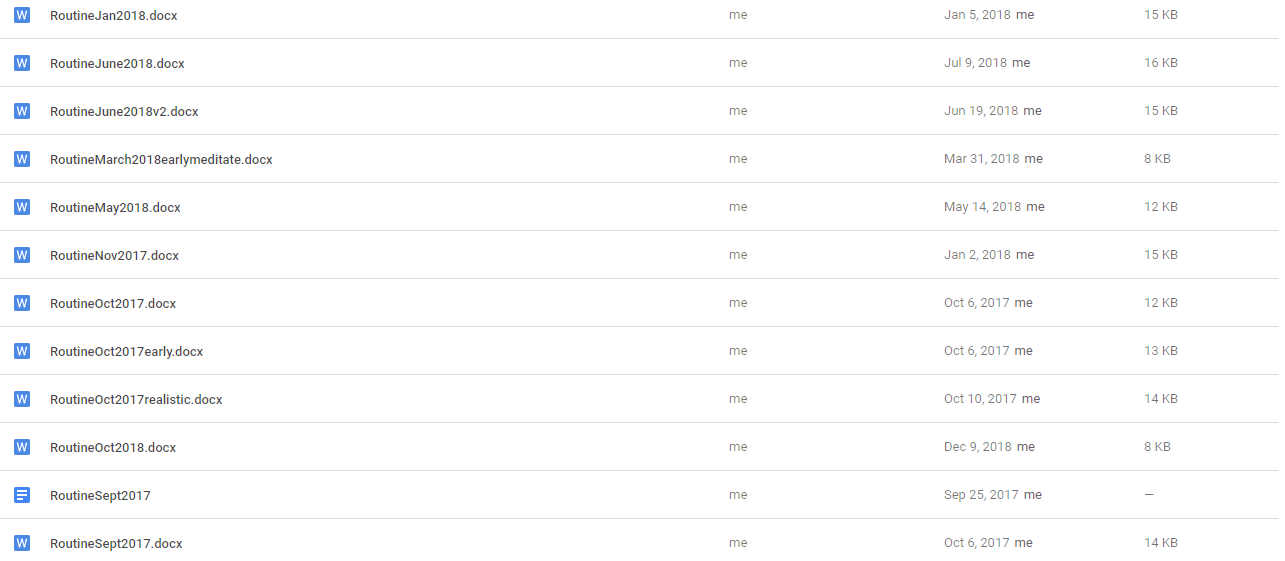
I don’t know if you know this about me, but I love routines. I looooove them. I love thinking about my routine, I love doing the things on my routine, and I love reading about other people’s routines (for instance, in articles like these). In fact, I have a folder on my computer (conveniently placed in the ‘Organization’ folder) called ‘Routine.’ This is a snapshop of some of the files in it:

What can I say? The routine is ever-changing.

Routine when pregnant… What?!

But then I got pregnant. Suddenly, I was more tired than usual, and I was nauseous during most parts of the day. Getting up at 6:30 simply didn’t work because I couldn’t keep my eyes open at work, and, what’s more, I felt more nauseous when I’d slept less. This was very frustrating because I’m usually a morning person (as I mentioned here), so I tried to make my usual routine work for me. This didn’t last very long–maybe 2 weeks max–because it made me exhausted and grumpy.

So I gradually made some changes. I started getting up around 7-7:30, and that felt much better. I was really nauseous in the morning, so I often lay down on the couch after breakfast–something I’d never do in the past because the morning was the time to go, go, go. However, even 5 minutes of lying down made me less nauseous and a little more refreshed, which felt immensely better.

I also often got nauseous at work, and it helped me to go for a brief (10-15 minute) walk. There was something about the fresh air and the movement that cleared my head. In fact, I was very rarely nauseous while walking.

However, sometimes I was just too tired to move around, so the office couch was my salvation. I’d lie down for 10-15 minutes and feel so much better afterwards! My office mates didn’t know I was pregnant back then, so they must have thought I was the laziest PhD student ever! The good thing was that this little horizontal break gave me energy, so I could keep working afterwards.

When the fog lifted

Fortunately, the nausea lifted around the end of the first trimester. Suddenly, I had my energy back! It felt amazing. Interestingly, I still need more sleep than before. While before pregnancy I felt great with 7-8 hours of sleep per night, now I consistently need 8-9 hours. If the alarm wakes me up with less than 8 hours of sleep, I am super disoriented, and I stay tired for the rest of the day.

Before getting pregnant, I used to wake up early, do my difficult and focused work early in the morning, do some admin or easier work in the afternoon, and exercise in the late afternoon. This worked well because I had lots of mental clarity in the mornings and more physical energy in the afternoon.

Funny enough, I don’t feel like much of a morning person these days. Some days I go to work early in the morning, expecting to have a few productive ‘golden hours.’ Instead, I feel groggy for the entire morning and only feel my energy pick up around ~11. I’m still surprised by this change and can’t quite understand it. Apparently, pregnancy leads to major changes in the body. Who knew!

The new routine!

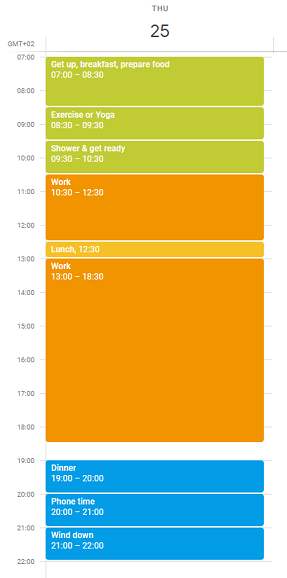
Armed with these new experiences, I set out to make a new routine for myself (yay!). I get up a little later now (at 7:00 or 7:30) and eat breakfast (I’m super hungry when I wake up). Then, I exercise or do yoga and shower afterwards. I find that having some physical activity in the morning gets me going and improves my focus. While in the past I’d get tired in the afternoons if I worked out in the mornings, this is not the case anymore. Perhaps it helps that my workouts and not as intense as before, so they wake me up rather than tire me out. In this way, by the time I feel energized and awake in the late morning, I can start working.

I am also able to focus quite well in the afternoon. After lunch, I make myself a delicious green tea and do my thing. (I avoid the after-lunch dip by eating a meal of vegetables, protein, and healthy fats; carbs make me sleepy, so I reserve them for dinner.) I enjoy the long stretch of time that I have available for my work between lunch and dinner. Sometime around 16:00 or 17:00, I go for a walk, which has a nice refreshing effect.

When I finish work, I go home, have dinner, and chill. Since the days are long here in the Netherlands and there’s sunlight until late in the day (around 22:00), I often may not notice that I’m tired. To avoid this, I set a bedtime alarm (of course I do! Are you even surprised?) for 21:00. At that time, I start winding down and read in bed for a bit with the curtains drawn to place myself in a dark environment. Amazingly, I’m usually asleep by 22:30 and get enough rest to wake up the next day at 7:00. You might think that with so much sleep I’d wake up before the alarm the next day, but nope! I’m usually surprised to hear the alarm go off. What, is it really time to wake up already?

For now this routine works, but who knows how long it will last for? I’m not even going to add it to my ‘Routine’ folder because I suspect it will be adapted very soon when the next change comes along. I’m becoming so flexible with my planning, what is happening to me?!

How does your routine change with time? Do you have a routine, or do you prefer to ‘go with the flow’? Let me know by commenting below or on FacebookTwitter, or LinkedIn.

How my husband and I decided to have a baby

We asked ourselves so many questions: “Are we ready to have kids? When is the right time to have a baby?” And perhaps the most difficult of all: “How do we know when we’re ready?”

“Kids are wonderful, but they also completely change your life.” At least that’s what I’ve heard–I have no experience myself, but that’s what people say. If having kids really is such a big life change, how do we decide when the right time is?

As you may have noticed, I like planning. Ironically, having kids is one of the most difficult things to plan in life. Does this mean we shouldn’t plan for it? I don’t think so. We can still create a draft plan and then adapt from there as life happens. One of the most important benefits of creating a plan is that it forces you to clarify to yourself what you want and why.

Early conversations

For Jacob (my husband) and me, talking about kids early on was very helpful. In the beginning of our relationship, we both mentioned that we’d like to have children one day, which was good to know.

A year later, we revisited the topic and decided we didn’t want to wait too long. It was 2017 at the time, so we said we’d probably start trying in 2019. That seemed a long while away, so we were relaxed.

Needless to say, I created three different timetables to visualize how starting at different times may develop over time. If we started trying in January 2019, assuming no complications or issues arose, we could be pregnant by July 2019. That meant the baby would be born by March 2020, and after that I’d take maternity leave (probably around 6 months). Afterwards, I’d resume my PhD by September 2020 and complete it (hopefully!) by the end of 2021. I created a table with the different time periods and also put them on a blank calendar with a yearly overview.

Then I did the same for two other starting dates. If we started trying six months later, everything would get shifted by half a year. In this case, especially if things didn’t happen too quickly, I was coming quite close to the end of my PhD, and being unemployed and pregnant seemed scary to me. And if we started trying once I was close to the end of my PhD, things would get shifted by about a year and a half. While that seemed less stressful (also because it was further away in time), it felt like too long from the present moment.

Is it really time?!

Towards the summer of 2018, we started thinking about it seriously. “Are we really going to start trying for a baby in 6 months?! That’s so soon!” Having a baby had always seemed like a huge deal to me, so it felt like the Earth should stop turning or something. But life was continuing around us at its usual speed: I was in the third year of my PhD, Jacob had started his own chiropractic practice, and we had scheduled our wedding for June 2019. Was it really the right time to have a baby?

At first, I told Jacob, “I think we should wait. I don’t think this is a good time for us to have a child.” He appeared a bit disappointed but conceded that we should start trying only when I was ready.

But then I remembered something a college professor of mine said to me one day: “It’s never the perfect time to have a baby. Don’t wait for the perfect time because it will never come.”

Remembering this stopped me in my tracks. What was I waiting for? We had a roof over our heads (a wonderful apartment, in fact), we were bringing in a decent income, we loved each other, and both of us were emotionally ready to have children. What more did I need?

Would it be better if we waited until after I finished my PhD? Maybe, but then I’d be looking for other jobs, so that would be stressful too. (Also, you can never know how long it will take to complete a PhD, so that’s a risky thing to bet on.) Would it be better if we waited until Jacob had been working at his practice for longer? Maybe, but we weren’t sure if that mattered so much.

Would it be a problem if I were pregnant at our wedding? (Spoiler alert: that was indeed the case.) I thought about this one long and hard. One of the main arguments against being pregnant at your wedding is that you can’t drink alcohol, but that didn’t bother me because I don’t drink alcohol anyway. My biggest issue was whether my wedding dress would look good. I can write much more about how I resolved this, but in the end I think it worked out well. And, finally, I was concerned that people would think we got married only because I was pregnant and not because we truly loved each other. Well, I had to let that go and accept that people would think whatever they want anyway.

Let’s go ahead…

In the end, we decided that the beginning of 2019 was as good a time as any to start trying for a baby. It wasn’t ideal, but it didn’t seem like we were going to find a more perfect moment. So we started, and here I am now, writing this blog post, and our tiny son is kicking excitedly in my belly. Yes, I’m writing about you, little one.

What do you think, how would you know (or how did you know) when you are ready to have kids? Let me know by commenting below or on FacebookTwitter, or LinkedIn.

Why I can be annoying on vacations

To be honest, I can sometimes be annoying on vacations. Most people like to let loose and relax when they’re on holiday. I also like to relax, but I can do that best if I have a tentative schedule.

Schedule on vacation

I like to know what we’re going to do: when we will wake up, where we will eat breakfast, what we will do afterwards, for how long, etc. Having that type of clarity allows me to relax and also to anticipate the joy of the upcoming day with excitement. As Gretchen Rubin says, looking forward to a pleasant experience is a great way to get happiness from it.

Of course, it’s fine if things change. It’s just that I like having an idea of how things might go. It also means that I get to discuss what I’d like to do and when with the other people, and they get to share what they want to do as well. So we can all, hopefully, be happy.

Wake up!

I also like to wake up early on vacation. I prefer not to have an alarm clock, but I still wake up relatively early–usually between 7 and 8 am. That’s why I like skiing and hiking holidays: everybody implicitly agrees that you need to get up somewhat early, be active during the day, and relax in the afternoon and evening.

I can trace this back to when I was a child. One summer when I was probably 7 or 8 years old, we went to the seaside with my parents’ friends. After dinner, the adults went out to party, but I was tired and went to sleep. In the morning, I woke up earlier than my parents, so I’d just go downstairs to the cafe and order pancakes. I’d eat my pancakes and read a book until my parents woke up and came to join me an hour or two later.

How funny it must have been for the waiters at the cafe: early in the morning, a kid eating pancakes and reading a book with a serious expression on her face. And when her parents show up, probably yawning, she scolds them, “What took you so long?”

“Come on, let’s go, what are you waiting for?”
And yes, this is actually me.

Time to relax

But I also get grumpy if a vacation is too packed. I like to be active, but I also like to relax. That’s why I don’t go on organized tours: they pack the schedule so full of stuff to do that there’s no time to relax anymore. How is that a vacation?

For the same reason, I don’t like doing hikes that are too long. When I was younger, we did hikes that were 10 or 12 hours long. That’s not my thing. I like to be active for a couple of hours, and then I like to chill. For me, that’s the best combination.

Last week at our honeymoon, Jacob and I made sure to combine being active and relaxing. On one of the days, he wanted to do a longer hike, which would have meant we missed our afternoon relaxing time in the spa area. I retaliated! I knew it was just one day, but I still wanted my relaxing time. In the end, we found a compromise, so all was good.

Be warned!

Sometimes, some people may think I’m a bit annoying to go on vacation with. (Okay, maybe it happens often, and it’s most people.) Apparently, not everyone wants to have a plan for the next day, to wake up early and be active, or to relax each day. To me, these things seem perfectly reasonable for a good vacation, so all I need to do is find people who share my preferences. But if you were considering going on vacation with me, be warned! 😉

What are your peculiar vacation traits? What annoys you that other people do when you’re on vacation together? Let me know by commenting below or on FacebookTwitter, or LinkedIn.

What I did to truly relax on my honeymoon

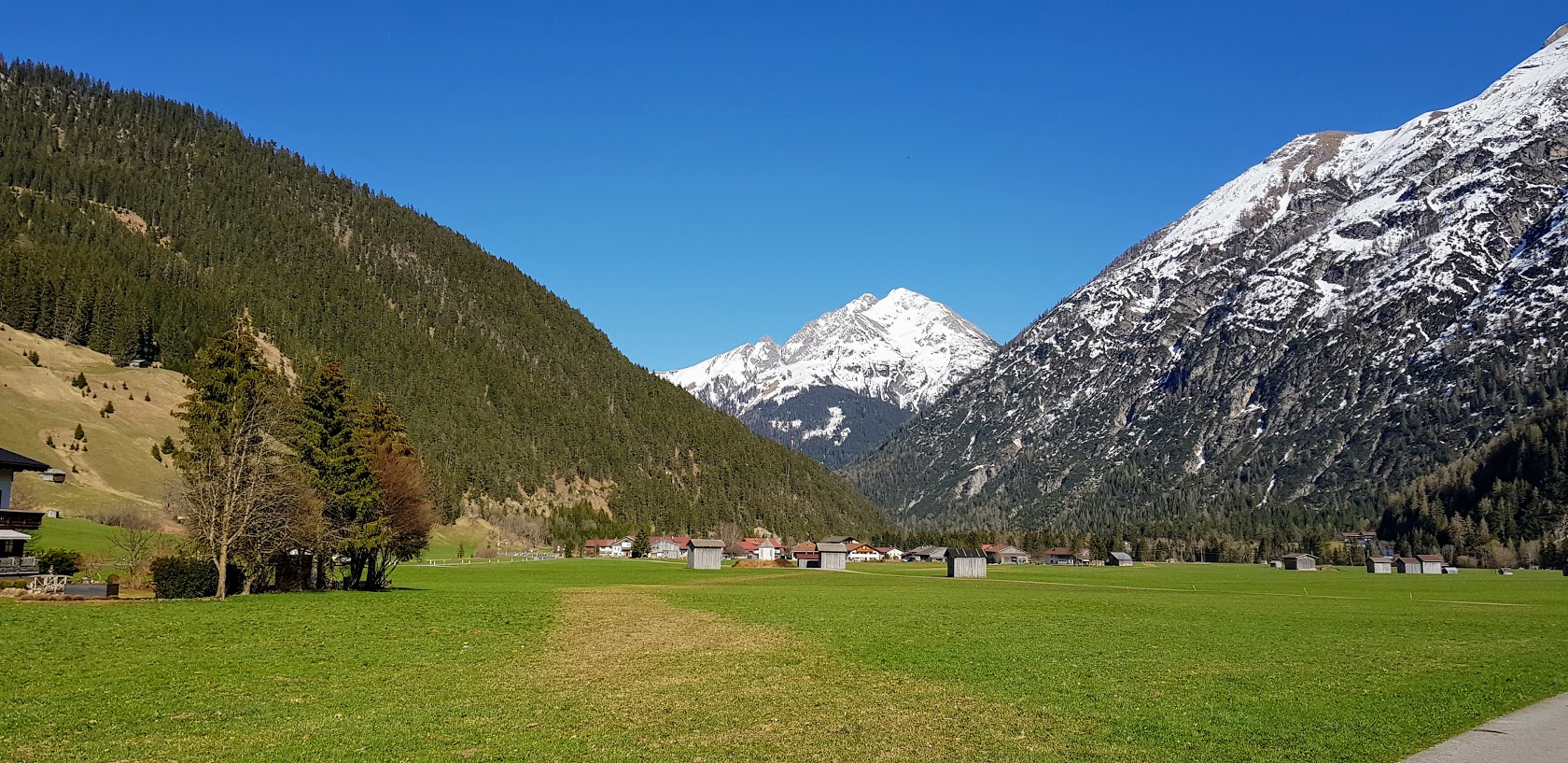
Last week, Jacob and I went on our honeymoon. It was an amazing trip, truly a dream come true. A few months before we got married, we started thinking about where we’d like to go, and I had this vision of a cottage in the Austrian Alps. I pictured a cozy, wooden house with flowers on the balcony, cuddled up in a valley between two mountains. Green grass in the valley, white snow on the mountains, and blue sky above.

This is what we saw when we stepped outside of our cottage.

And this was exactly what we got. Everything was wonderful, and we managed to enjoy it thoroughly. But how did we do that?

Sometimes when we go on vacation, we have trouble letting go and relaxing. We keep thinking about work, about unfinished business in the office or at home, or about something that is stressing us out. This time, we could have also slipped into that trap. I could have thought, “Will I have enough time to finish editing my paper? When will I start my new experiment? I have so much work to do!” Jacob could have worried about how his practice is doing or about the content he needs to write for his website. There are always plenty of things to worry about.

This is what we did to get our peace of mind.

Disconnect

I didn’t check my work email or Slack. Not even once. Woohoo! I knew that if I checked them, I’d be sucked in, and I’d feel as though I urgently had to respond to a request or a question. Fortunately, my job has very few urgent things in general, so even when I did check my email the following Monday, there was absolutely nothing urgent. How nice!

Now, Jacob’s situation is different. He works with patients, and he needs to be somewhat accessible in case someone needs a timely response, so he couldn’t not open email. What he did was that he only checked his phone (email, messages, etc.) twice a day: once in the morning and once in the evening. If somebody required an immediate response, he answered briefly, giving them the information they needed but also letting them know that he would provide a thorough response as soon as he got back.

We even took a break off of social media. That was quite nice because being more disconnected from the world in general made us more connected to the present experience, to the wilderness, and to each other. We even told each other stories from our lives that had never come up before! Who knew there were any stories left untold! (Let’s check again in 20 years…)

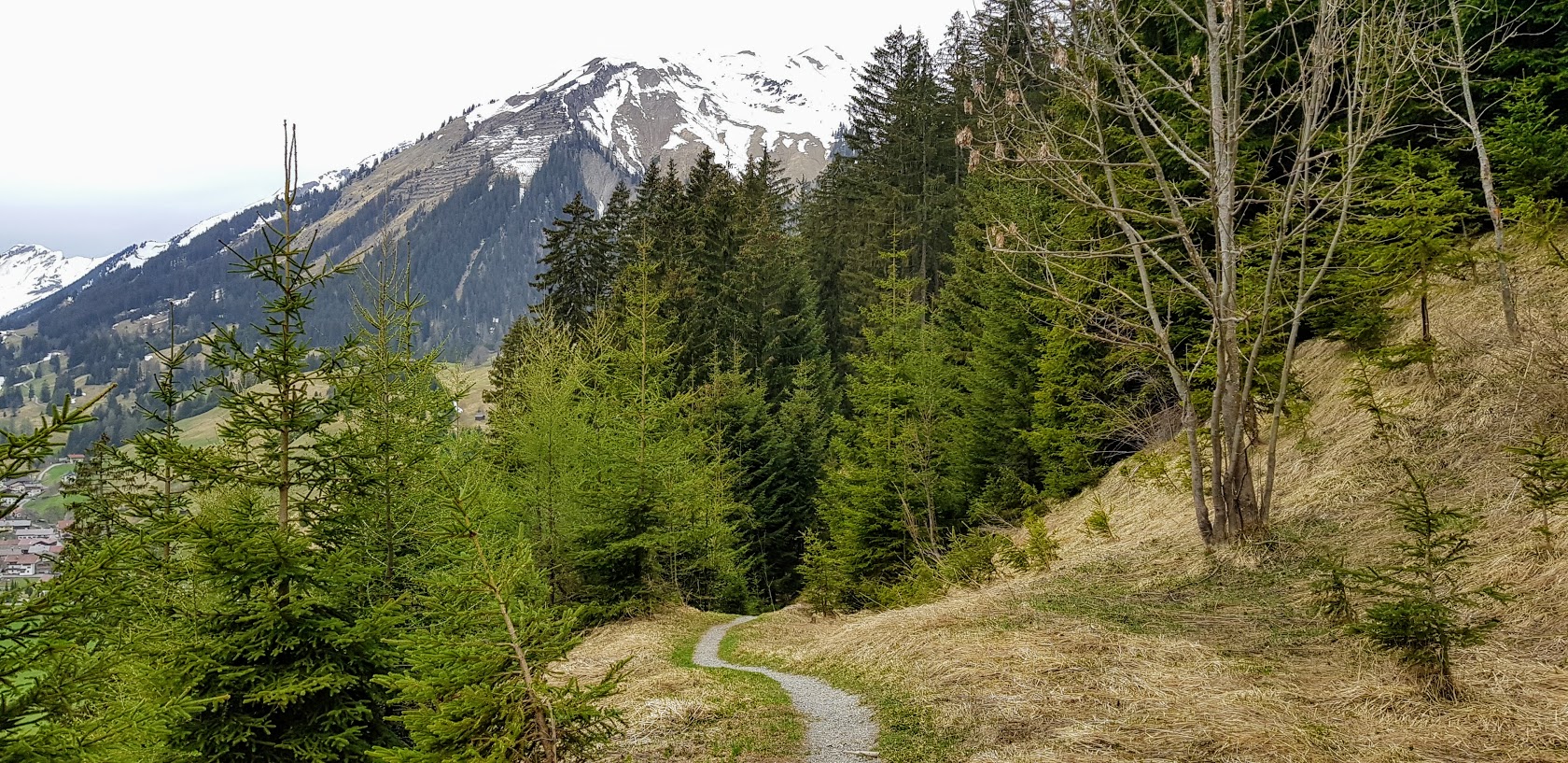
This was one of our favorite paths, winding among the trees.

Find other engaging things to do

I know for myself that if I’m doing nothing all day, my mind wanders to some unpleasant things, and then I start worrying. If my mind is left to its own devices, it would probably drift back to what it’s used to thinking about: work and questions about the future. To avoid that, I need to give my mind something engaging to think about.

Since we were in the mountains, we went hiking every day. There were many routes we could take and many places we could visit. So, each evening we checked the weather for the following day, the available routes, the open lodges/huts, the difficulty and length of the routes, etc. We also took into account how tired we were from the day’s hike and decided on which route to do. It was a lot of fun, and we did many cool routes.

In the morning, we’d get up, have a delicious breakfast (my absolutely favorite meal of the day!!!), and head out for the day’s hike. It was exciting to do a new route each day and reach a different hut.

Also, once we arrived and wanted to have lunch, we had to figure out what the Austrian names for the different dishes actually meant. On the first few days, we had some surprising food experiences (such as ham-and-cheese salad which is not a salad at all!), but that also kept things interesting. In the end, we found some truly delicious soups, such as frittata soup and bacon-noodle soup. And, naturally, we had lots and lots of sauerkraut.

I also did quite a bit of reading. In the afternoons after we came back from hiking, we went to the spa area to relax properly. My favorite part was the relax zone, a quiet area with big, tall windows, letting the sunlight in and allowing a gorgeous view of the snowy mountains. There were these wooden swing lounging chairs (that’s my best attempt at an explanation) where you could lie, enjoy the sun and the view, and read. Also, I was reading a very exciting novel, so I didn’t want to leave at all. That was my favorite part of the day.

The gorgeous view from a peak that was very steep and slippery but so worth it!

Dive in

I think this is the key to why I managed to relax and let go on this holiday: I took steps to (1) disconnect from my everyday world and (2) actively engage with the world around me at that moment. And it worked! So much so that we didn’t want to leave… One more honeymoon, maybe? Hmm.

How do you relax when you’re on vacation? Or do you find it difficult to stop thinking about your regular life? Let me know by commenting below or on FacebookTwitter, or LinkedIn.

How being ill surprisingly boosted my productivity

How I managed to do my work while also resting and recovering.

I don’t get ill often, which is also why when I do get ill, I feel like I don’t know what to do. A couple of weeks ago, I caught a cold, and it wasn’t pretty. While I was sneezing and coughing and my body didn’t want to get out of bed, my mind was still going.

“We need to do that analysis,” my mind would say. Or, “I really wanted to finish writing that paper!” Or, my favorite, “But we have that meeting, how could I possibly miss it?!”

But, perhaps most importantly, I felt it was unfair to expose other people to my germs. That feeling of responsibility kept me away from work and at home. I think that was a good thing because my husband, who came into extensive contact with my germs, got ill with the same symptoms 3 days later.

(Of course, in his case it was much worse because he had the mancold. At the worst point of the coughing and fatigue, he announced that he was on his death bed. After a “fever” of 37.8 degrees Celsius, he was convinced he had pneumonia. I shook my head and made him ginger tea. One of the best things about marriage is that you can be ill together.)

Fortunately for me, I can easily do my work from my laptop at home, so I just stayed put for 5 days. I slept as much as I could (didn’t use an alarm to wake up and took a nap during the day), drank tea, ate good food, and stayed warm.

I went for short walks at first and, as I felt a bit better, the walks got slightly longer. I didn’t strength train for a whole week, which was very difficult to accept but highly necessary.

To be honest, my work went surprisingly well during that time. Staying at home forced me to focus on the important tasks and disregard distractions. One evening, I was so tired that I went to bed at 9 pm and woke up at 4 am, fresh and energized. I seized the opportunity and worked on my paper for several hours straight. I managed to edit the manuscript until I was satisfied with it, and I sent it to my supervisor. Then, with a feeling of great achievement, I went back to sleep.

I also had a lot of quiet time for reading papers, which informed my ideas for a new project. I needed to think about how to design my next experiment, which is a huge step and a very important one. I wanted to come up with a sound experimental design because otherwise my whole experiment would be flawed. By the end of my home stay, I had a cool idea for my new experiment, which I am now refining and will hopefully implement soon.

In the end, I was surprised by how productive this period of illness was for me. The physical sickness constrained me to staying at home, which in turn made me focus on the big, difficult tasks I would have tried to postpone had I been in the office by going to meetings, talks, other people’s projects, etc.

It was also very helpful that I actually gave myself time to recover. When I needed to sleep, I slept. When I was exhausted and needed to do something chill like reading a paper, I did that. I really gave myself the time to rest and didn’t push myself to go to the office when I was feeling ill.

After all, this cold didn’t turn out to be too bad work-wise. But I’m glad it’s over, and I hope I won’t be constrained to working from home again soon. Being in the office and seeing people (and talking to them) is so much more fun!

What do you do when you’re ill? How do you cope? Do you go to work, do you work from home, or do you drop everything and lie in bed? Let me know by commenting below or on FacebookTwitter, or LinkedIn.

Photo by Lisa Fotios from Pexels

Happy birthday to me and a question for you!

Yesterday was my birthday (yay!), and reflecting on the past year got me into a bit of a contemplative mood, so I have a couple of questions for you.

I wanted to take this opportunity to thank you for reading my blog posts and following along with my work. It means a lot to me that people are finding the info I share interesting and useful. It makes me really happy when I see that somebody has read my blog post, and I do a little victory dance every time somebody leaves a comment.

In order to provide information that’s interesting and useful to you, I’d like to ask you a couple of questions:

  • What do you struggle with in terms of organization, time management, and lifestyle?
  • What works particularly well for you in this respect?
  • What topics would you like me to cover?
  • What specific questions do you have?

Let me know! I’m really curious to hear from you 🙂

Let me know by commenting below or on FacebookTwitter, or LinkedIn.

Photo by Pineapple Supply Co. from Pexels

How to never forget a to-do again

On some days, our minds are super busy, and we have many thoughts and to-do’s floating around.

“I should buy some lemons.”

“Oh, I should also call my dentist.”

“Also, I should make a reservation for dinner.”

These thoughts all feel important because they are things we want to or have to do. “I shouldn’t forget to make a reservation!” Each thought comes with a sense of urgency, so we can’t afford to forget it.

This roller coaster is quite exhausting. What’s more, it keeps our mind occupied, so there’s less capacity for interesting, creative, or productive thoughts.

The Inbox

A great solution comes from the Getting Things Done method by David Allen (you can read my blog post about it here). This solution is to keep an Inbox where you dump all such thoughts. The Inbox can be a notebook, a text document, or an app on your phone. It doesn’t matter what it actually is as long as:

  • It reliably keeps your info (e.g., it’s not an app with bugs that loses certain entries, and it’s not a bunch of post-it notes that can easily get lost around the house);
  • It is easy for you to browse, so you can see what you’ve written down (e.g., it’s not a huge, messy notebook where your to-do’s get lost, and it’s not an app that’s organized in a way you don’t understand, making it difficult to find your entries);
  • It is always on hand for you (i.e., it’s not helpful if you left your notebook at work, and then at home you don’t have a place to write down the to-do’s that come to mind.

For me, it is convenient to use an app for this. I use Wunderlist or Trello, depending on what the to-do is about. I have both apps on my phone and on all my devices, so it’s easy to jot something down. (See this blog post for an extensive description of the tools I use.)

The surprising power of writing things down

One participant in my bootcamp course on organization and time management, Angela, said the Inbox method was immensely helpful for her. She used to try to remember everything she needed to do, inevitably ending up overwhelmed and forgetting something.

“Since I’ve started writing down all my tasks, I feel like I’ve freed up so much mental space,” Angela shared. “A lot of the anxiety is gone because I know that if I need to do something, I won’t forget it–it’s on my list!”

Angela’s enthusiasm about this discovery caught me by surprise. It’s such a simple thing to do that I’d forgotten its power. I must have been doing this for almost 10 years already, since I read David Allen’s book Getting Things Done for the first time.

I remembered the relief and decreased anxiety I had experienced back then when I discovered this simple way of dealing with the ever-present thoughts about endless to-do’s. It really is so simple: Write it down. Get it out of your head. The simplest things often are the most powerful.

Have you tried this? How do you deal with endless thoughts about to-do’s? Let me know by commenting below or on FacebookTwitter, or LinkedIn.

Featured image by Tirachard Kumtanom from Pexels