For those first ten days or so after we lost our baby halfway through the pregnancy, I was in a phase I called ‘brain rewiring.’ A huge change had taken place in our lives, and my mind was struggling to get used to it.
Integrating two narratives
On the one hand, I could remember in vivid detail how I’d given birth to our tiny baby and then we’d had to say goodbye. On the other hand, I kept forgetting that I was no longer pregnant.
At one moment, I was having an intense conversation with a friend about the current state of the pandemic, totally engulfed in big thoughts about the state of the world and no thought about my personal experience. A couple of hours later, I felt such pain and grief that I threw myself on the couch and cried, all thoughts of the global pandemic forgotten.
I kept having thoughts such as, “Since I am no longer pregnant, I can drink wine again,” but they only brought me sadness. I didn’t want to be able to drink wine; I just wanted to be pregnant again.
In fact, I didn’t want to be pregnant anew, but rather I wanted to still be pregnant. I wanted to go back in time and make it as though the events of the past two weeks hadn’t happened. And then I was faced with the stone-heavy realization that that wasn’t possible. In that moment, my heart fell through the floor.
During those nights, I dreamed about a baby and a pregnancy and all sorts of related (or unrelated) things. In the dreams, I carried the sadness of losing our baby, but upon waking, for the first second or so, I thought, “Oh, it was just a dream, thank God! My baby is still here…” And then I’d remember that he wasn’t here and that it was in fact all true. That fact hit me like a train, crushing me. It felt impossible to accept or bear that truth.
Slowly, my brain started integrating the new truth about our life. At the beginning of the process, there was our life on the one side and this terrible, tragic thing that happened to us on the other side. At the end of the process, this tragic event was integrated into the narrative of our life, our world. It had become a part of us.
What is “brain rewiring” anyway?
I first coined the term “brain rewiring” during a heavy break-up way back in college. The change was so painful and difficult that, once again, I was struggling to integrate the world I had known with the world I lived in now. It took a few weeks before the knowledge of the break-up and how that affected all aspects of my life was integrated within me and no longer shocked me with its harshness.
By calling it “brain rewiring,” I took the subjective aspect out of it. It wasn’t that “I couldn’t accept the break-up yet,” but rather “my brain needed time to create new neural pathways to reflect the change.” As you may have guessed, I was a psychology and neuroscience major in college back then. Who would have guessed I’d do a PhD in neuroscience after that?!
The “brain rewiring” stage has been the most painful one for me (so far) during this grieving process. I believe that’s because I was constantly being faced with the shock of what happened and the magnitude of the loss. Beyond that shock, there is pain and sadness that’s about the actual loss and about our baby boy, but the shock makes it impossible to find acceptance for those emotions.
Once I moved through the “brain rewiring” stage, I felt sadness, but it wasn’t anymore the raw pain that hits you head-on. It became more of a quiet sadness rather than a train crushing me. I’m not saying that quiet sadness is good, but it felt more bearable to me.
Thank you, brain
There is something amazing about the “brain rewiring” stage: it seems to me that the brain must be working overtime then. It must take so much work to update so many beliefs, expectations, and memories and to integrate this colossal event into my sense of self. For that, I feel a sense of gratitude towards my brain. Thank you, dear brain, for working so hard to make sense of this, to accept it, and to weave it into the narrative of who we are. I know it’s hard, and I thank you for all you do. (Yes, I speak to my brain. It speaks back sometimes. You can make what you want out of this.)
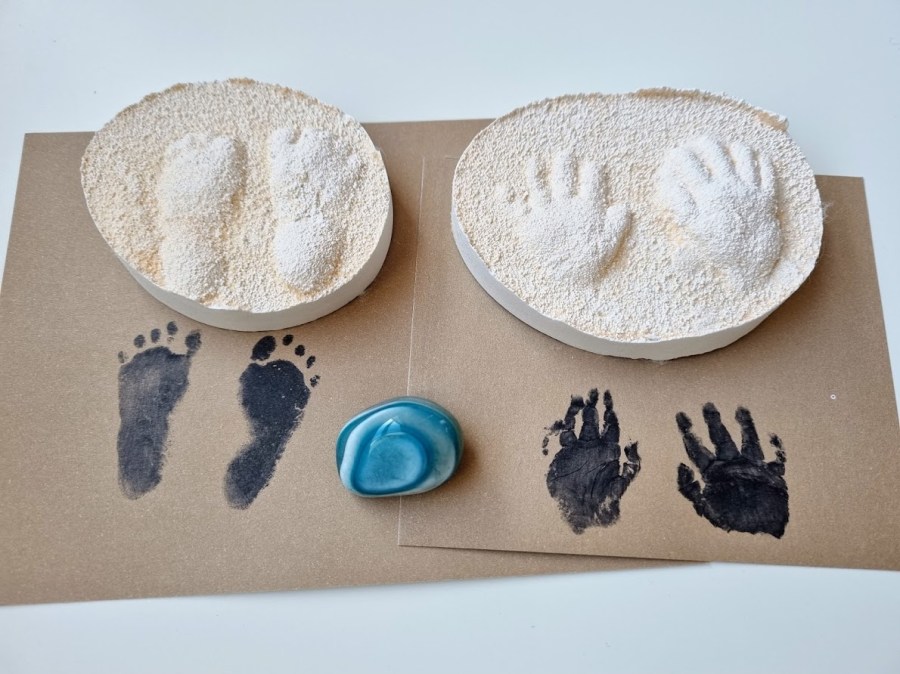
Photo: Prints of our baby’s hands and feet. They are tiny.

 A Good Life